Chartered Accountants in Nigeria come under the purview of Anti – Money Laundering(AML) compliance as they are classified as Designated Non – Financial Businesses and Professions(DNFBPs) according to the Money Laundering(Prevention and Prohibition) Act, 2022, referred to as Nigeria’s MLA, 2022. This blog attempts to draw out the Anti – Money Laundering (AML) compliance for Chartered Accountants in Nigeria including the Counter – Financing of Terrorism, and Counter – Proliferation Financing (CFT,CPF) compliance requirements.
The MLA, 2022, requires accountants in Nigeria to comply with AML compliance requirements for Chartered Accountants in Nigeria taking into account the applicable AML/CFT/CPF legal framework. The Institute of Chartered Accountants of Nigeria(ICAN) is the governing body that controls the accounting profession in Nigeria.
AML / CFT Legal Framework in Nigeria
The AML / CFT legal framework in Nigeria impacting chartered accountants consists of the following laws and regulations:
- The Money Laundering (Prevention and Prohibition) Act (MLA), 2022 (MLPPA)
- Brings licensed professional accountants under the purview of DNFBPs.
- The Terrorism (Prevention and Prohibition) Act, 2022 (TPPA)
- Charts out Targeted Financial Sanctions (TFS) measures to be undertaken by DNFBPs.
- The Proceeds of Crime (Recovery and Management) Act, 2022
- Draws out record-keeping requirements in alignment with Financial Action Task Force (FATF) recommendations.
- Economic and Financial Crimes Commission (Anti-Money Laundering, Combating the Financing of Terrorism and Countering Proliferation Financing of Weapons of Mass Destruction for Designated Non-Financial Businesses and Professions, and Other Related Matters) Regulations, 2022
- Regulates DNFBPs and Professionals in Nigeria for AML/CFT and CPF compliance.
Forewarned Is Forearmed
Discover The AML/CFT/CPF Duties Every Chartered Accountant Must Meet in Nigeria.
AML Compliance Requirements for Chartered Accountants in Nigeria
Chartered Accountants must ensure compliance with the following AML compliance requirements for Chartered Accountants in Nigeria:
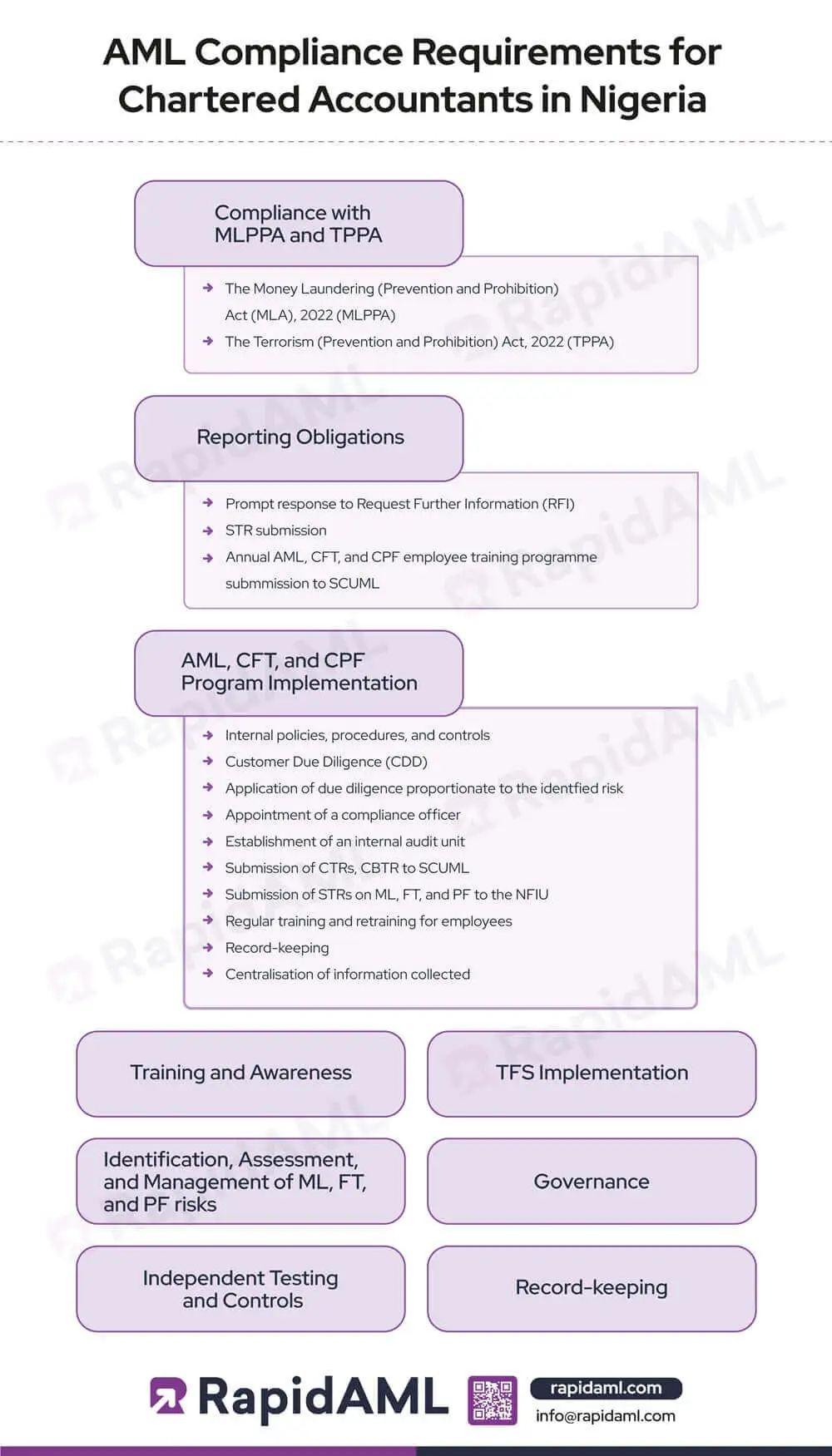
1. Compliance with MLPPA and TPPA
The provisions of MLPPA and TPPA need to be adhered to. Chartered Accountants must ensure compliance with legal obligations provided for and under these acts as part of the AML compliance requirements for Chartered Accountants in Nigeria.
2. Reporting Obligations
- Prompt response to RFI he Nigerian goAML administration guide provides steps for DNFBPs to promptly respond to Request Further Information (RFI) through the goAML message board. Through the goAML portal, a chartered accountant subject to AML compliance can find which reports require RFI and complete the requirement through the portal promptly.
- STR submission The MLPPA requires suspicious transaction reporting (STR) submission, which is a key component of the AML compliance requirements for Chartered Accountants in Nigeria. It requires chartered accountants to file STR within 24 hours after the transaction has taken place by drawing up a written report that contains all relevant and necessary details such as the identity of the beneficiaries of such transactions, actions and measures taken to file such report, and so on to Nigerian Financial Intelligence Unit (NFIU).
- Annual AML, CFT and CPF employee training programme submission to SCUML Chartered Accountants are required to submit a yearly report on the measures taken to train employees on AML/CFT and CPF controls every year prior to 31st March, in line with AML compliance requirements for Chartered Accountants in Nigeria.
3. AML, CFT and CPF Program Implementation
Chartered Accountants in Nigeria are required to ensure compliance with the AML / CFT and CPF laws and regulations.Discussed below are the AML compliance measures that chartered accountants in Nigeria need to implement, such as:
- Internal policies, procedures, and controls: Chartered Accountants must have in place adequate internal AML /CFT and CPF policies, procedures, and controls to counter ML, TF, and PF as required under the AML compliance requirements for Chartered Accountants in Nigeria.
- Customer Due Diligence (CDD): Chartered Accountants must keep a documented record of the CDD measures they intend to implement during the customer onboarding and ongoing monitoring of business relationships. The CDD measures must clearly state the methods used for customer onboarding and customer screening.
- Application of due diligence proportionate to the identified risk: Chartered Accountants in Nigeria must adopt a Risk-Based Approach (RBA), implementing risk mitigation measures proportionate to the identified risk in accordance with AML compliance requirements for Chartered Accountants in Nigeria. Implementation of overly stringent AML measures hampers business, whereas lenient measures may let criminals pass through the mitigation measures and misuse the chartered accountants’ operations for their illicit activities.
- Appointment of a compliance officer: The AML compliance requirements for Chartered Accountants in Nigeria need to appoint an AML compliance officer to oversee AML controls across headquarters, branches, and local offices.
- Establishment of an internal audit unit: An internal audit unit must be established to ensure compliance with implemented AML/CFT and CPF measures and identify gaps, if any.
- Submission of CTRs, CBTR to SCUML: Chartered Accountants in Nigeria must ensure the filing of Currency Transaction Reports (CTRs) and Cash Based Transaction Reports (CBTRs) to the SCUML whenever such a situation necessitating the filing of such reports arises.
- Rendition of Suspicious Transactions Reports (STRs) on ML, TF, and PF to the NFIU:
Chartered Accountants must ensure timely filing of the STRs in a proper narrative with the NFIU.
- Record keeping:
The records such as transaction records, cash transaction registers, and files, correspondences, and communications with clients must be stored for a duration of 5(five) years.
- Centralisation of information collected
Chartered Accountants must take measures to make available the information collected by their business centrally throughout all branches and offices.
Look Before It Leaps
Explore How Risk-Based Due Diligence and Record-Keeping Obligations Help Nigerian Accountants.
4. Training and awareness
Entities must train their employees on the implementation of AML / CFT and CPF compliance requirements for Chartered Accountants in Nigeria in accordance with internal policies, procedures, and controls.
Chartered Accountants must retrain their employees as and when there is any regulatory or policy change.
5. Targeted financial sanctions implementation
The TPPA prescribes implementing TFS measures by DNFBPs, requiring chartered accountants to screen their customers across relevant and applicable sanctions lists to identify if any of their customer names come into any of the sanctions lists.
6. Identification, assessment and management of ML, FT, and PF risks
CChartered Accountants must take adequate measures to identify, assess, and manage ML/FT and PF risks they are exposed to under the AML compliance requirements for Chartered Accountants in Nigeria. This requires a risk – based approach while devising strategies to counter the ML, FT, and PF risks, supported where appropriate by the use of AML software solutions.
7. Governance
The governance structure of a chartered accountant’s practice must include responsibility for overseeing AML/CFT and CPF regulations as mandated by AML compliance requirements for Chartered Accountants in Nigeria, a designated chief AML compliance officer must be appointed who acts as a point of contact between the employees and the senior management of a chartered accountant firm and ensures communication with regulatory bodies while ensuring timely filing of regulatory reports.
8. Independent testing and controls
The independent AML audit that tests the efficacy of AML control measures deployed by a chartered accountant firm and looks for any discrepancy or redundancy in the compliance process devised for the firm. The independent testing and controls help ensure that the findings of such AML audits are unbiased and fair, giving a clear picture of the AML / CFT and CPF measures.
9. Record – keeping
Chartered Accountants need to ensure to align with the AML compliance requirements for Chartered Accountants in Nigeria including record-keeping obligations prescribed by laws and regulations under the regulatory authority whenever needed.
Conclusion
The chartered accounting profession is governed by the AML / CFT and CPF laws in Nigeria. AML compliance requirements for Chartered Accountants in Nigeria requires Chartered Accountants to must have adequate and appropriate AML/CFT and CPF policies, procedures, and controls in place based on the requirements prescribed in the laws and regulations, which can be effectively supported through solutions such as RapidAML. The Institute of Chartered Accountants of Nigeria is the governing body that controls the accounting profession in Nigeria in relation to AML compliance requirements for Chartered Accountants in Nigeria.
Fill the Costly Compliance Gaps
RapidAML Identifies Common Pitfalls and Ensures Your Accounting Practice Meets AML/CFT Requirements.