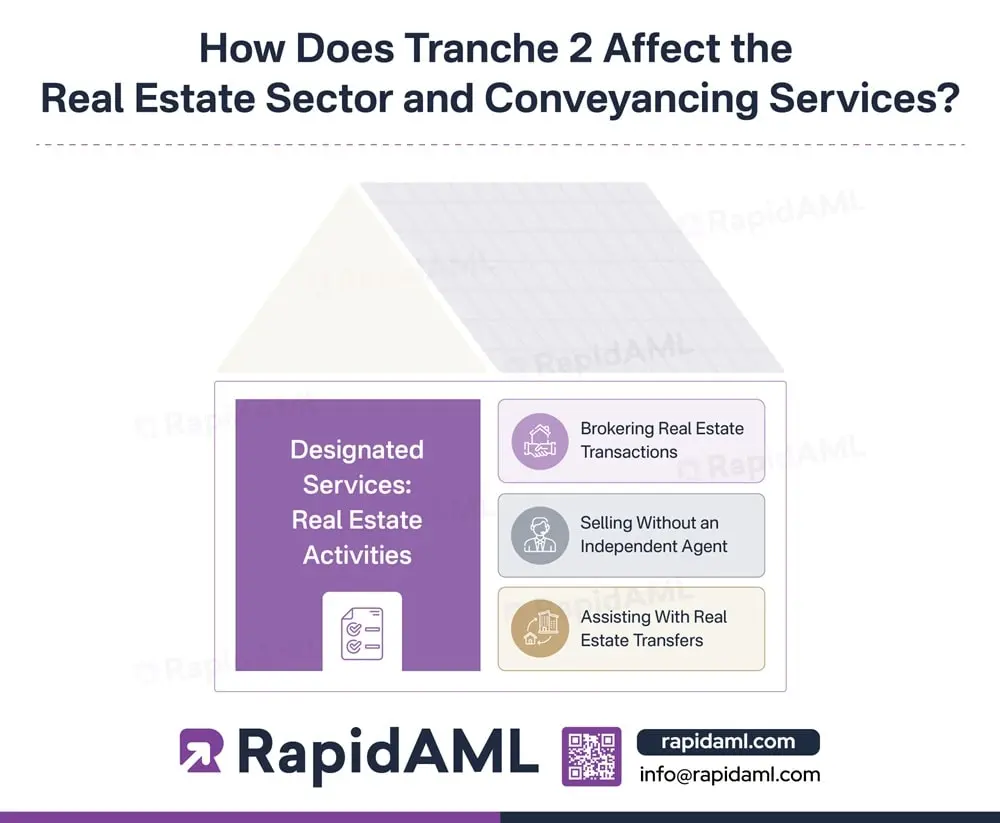
This infographic explains how AML/CFT Obligations will be applicable to the Real Estate Sector and Conveyancing Services, two of the Tranche 2 Entities under the Anti Money Laundering and Countering of Terrorism Financing (AML/CTF) Amendment Act 2024. Real Estate Professionals, including agents, and developers as well as conveyancers involved in property transactions, must now follow AML/CFT Rules when providing designated services with a geographical link to Australia.
However, some activities with less substantial rights over land are not included, such as leases of 30 years or less, incorporeal hereditaments (e.g. easements), mortgagee interests, and general property management.
Under the Tranche 2 AML/CTF Reforms, services such as brokering real estate transactions, selling without an independent agent, or assisting with real estate transfers must comply with new Tranche 2 regulations for Real Estate. These inclusions reflect the focus on safeguarding Australia’s property market from money laundering and ensuring greater accountability across all stages of real estate transactions. However, some activities with less substantial rights over land are not included, such as leases of 30 years or less, incorporeal hereditaments (e.g. easements), mortgagee interests, and general property management.
The following are the three key designated services covered under Tranche 2 regulations for Real Estate:
Under the AML/CTF Amendment Act 2024, brokering real estate transactions is now covered under the Tranche 2 regulations for Real Estate. This applies whenever a business arranges the sale, purchase, or transfer of real estate on behalf of a client. The obligations extend to both buyer’s agents and seller’s agents, meaning property dealings on either side of the transaction are captured.
For brokering real-estate transactions under Tranche 2 both parties to the transaction are considered customers:
a) The seller or transferor; and
b) The buyer or transferee
Legal Reference: This is listed under Item 1, Table 5, AML/CTF Amendment Act 2024.
Example: A real-estate agent assisting a client to purchase a home is carrying out a service that falls under the AML/CTF Tranche 2 regulations for Real Estate.
Under the AML/CTF Amendment Act 2024, selling or transferring real estate directly, without the involvement of an agent, is covered under the Tranche 2 regulations for Real Estate. This includes developers selling new apartments, house and land packages, or blocks of land directly to buyers.
For this type of real estate transaction under Tranche 2, the buyer or transferee is considered the customer while providing the service.
Legal Reference: This is listed under Item 2, Table 5, AML/CTF Amendment Act 2024.
Example: A developer managing the sale of off-the-plan apartments directly to purchasers is carrying out a service that falls under Tranche 2 AML/CTF obligations.
Under the AML/CTF Amendment Act 2024, assisting with real-estate transfers is a designated service regulated under the Tranche 2 regulations for Real Estate. This applies when legal professionals or conveyancers assist in planning, executing, or finalising the sale, purchase or transfer property.
In such cases, the individual for whom the service is being carried out is treated as the customer.
Legal Reference: This is listed under Item 1, Table 6, AML/CTF Amendment Act 2024.
Example: A conveyancer preparing contracts or handling settlement arrangements for a client purchasing a property is carrying out a service regulated under the Tranche 2 AML/CTF Framework.
Exclusion: Real Estate transfers ordered by a court or a tribunal are not covered. For example, transfers from a divorce settlement or from a deceased estate under probate orders fall outside these obligations.
Key Takeaway
If a business is engaged in real estate brokering, selling property without an agent, or assisting with transfers through legal or conveyancing services, it will fall under the Tranche 2 AML/CTF regulations. These reforms are designed to limit criminal misuse of Australia’s property sector and to increase transparency in real estate transactions.
It is essential for businesses to assess whether their services fall into these categories and begin preparing for compliance well before the July 2026 deadline, including adopting suitable AML Software and solutions to strengthen monitoring, verification and reporting capabilities.
Real Estate Just Got Risky
With RapidAML, Build Trust, Avoid Penalties, and Stay Ahead with a Solid AML/CTF Framework
Get Started
Contact Us