
Australia’s Anti Money Laundering and Counter Terrorism Financing Rules 2025 (AML/CTF Rules 2025) represent more than just a regulatory update; they signal a clear shift in the country’s approach to compliance. Made under the AML/CTF Act 2006, these rules were signed on 29 August 2025 and will come into effect on 31 March 2026.
The delayed start is practical, as it gives businesses time to rethink their systems, adjust governance processes, and prepare for the broader scope of obligations.
Compared to what was built earlier, the 2025 Rules do more than consolidate requirements; they expand them. Reporting Entities, Remittance Network Providers, and Virtual Asset Service Providers (VASPs) remain under the regulatory umbrella, but Real-Estate Transactions now fall squarely within the Rules’ reach. Clear definitions of Domestic Politically Exposed Persons (PEP) further bring Australia closer to international standards.
Australia’s AML/CTF Rules 2025 bring a wider net of regulation, aiming to close long-recognised gaps in Australia’s compliance frameworks. While familiar entities remain under AUSTRAC’s oversight, the reforms also reach into sectors that have historically operated with lighter scrutiny.
Reporting Entities
At the core, Reporting Entities continue to carry the bulk of compliance obligations. These include banks, financial institutions, designated service providers, etc., that already form the backbone of Australia’s AML/CTF regime. For them, Australia’s AML/CTF Rules 2025 largely reaffirm existing duties but demand a stronger emphasis on governance and accountability at the organisational level.
Remittance Providers and VASPs
Remittance Providers and Virtual Asset Service Providers continue to be key points of attention. Given the speed and opacity of cross-border value transfers, these entities are now required to apply Enhanced Due Diligence (EDD) and strengthen transaction monitoring practices.
Real Estate Transactions
A significant development is the explicit extension of obligations to Real Estate transactions. Property dealings, often flagged as a channel for laundering illicit funds, are now directly regulated. This change brings Real Estate agents, developers, and settlement providers within AUSTRAC’s supervisory scope.
Domestic Politically Exposed Persons
Australia’s AML/CTF Rules 2025 also introduce detailed categories of Domestic PEPs. By requiring closer scrutiny of politically sensitive clients, Australia moves into closer alignment with international standards on high-risk customer groups.
The broadened scope ensures Australia’s AML/CTF framework closes loopholes, strengthens oversight, and aligns more closely with international compliance standards.
Australia’s AML/CTF Rules 2025 modernise it’s compliance framework. They consolidate earlier obligations, expand regulations to new sectors, and refine Customer Due Diligence processes to address evolving risks.
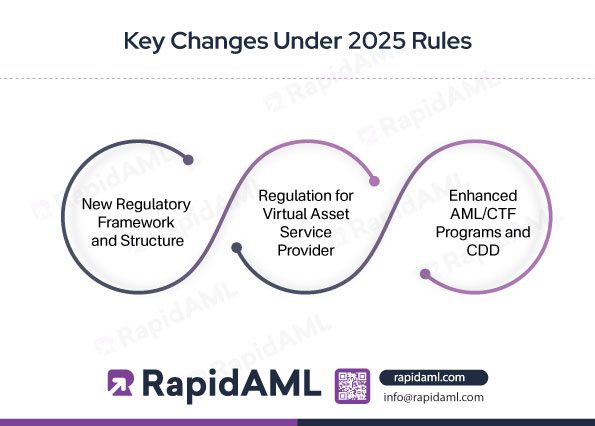
New Regulatory Framework and Structure
Replacing the former framework, Australia’s AML/CTF Rules 2025 adopt a streamlined framework of twelve parts. This consolidated approach clarifies obligations, making compliance more accessible, while providing a transitional commencement date of 31 March 2026 for entities to adapt.
Explicit Regulation for Virtual Asset Services
For the first time, VASPs are directly regulated. Establishment of a VASPs Register is provided with detailed application requirements along with inclusion of policies on wallet types, regulatory licensing, and secure transfer information into AML/CTF programs.
Enhanced AML/CTF Programs and CDD
Programs must now address Proliferation Financing Risks, Targeted Sanctions, and specific rules for Real Estate. Along with that, CDD obligations are refined, requiring deeper ownership checks for non-individuals, ongoing reviews for high-risk clients, and stricter rules for reliance on third parties.
Australia’s AML/CTF Rules 2025 establish a robust framework of compliance obligations designed to strengthen governance and accountability across Reporting Entities. The obligations are far more comprehensive than in earlier frameworks, reflecting both domestic priorities and international Financial Action Task Force (FATF) standards.
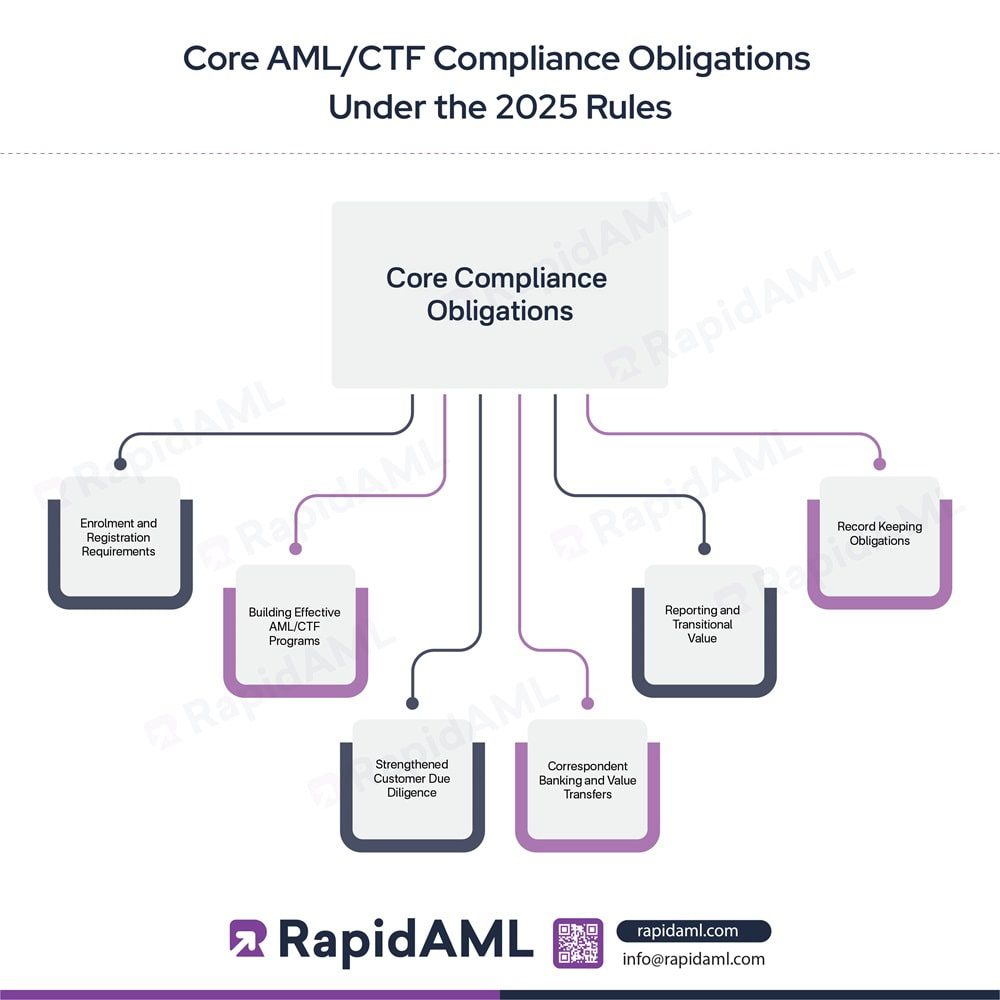 Enrolment and Registration Requirements
Every Reporting Entity must complete an updated enrolment process, disclosing ownership structures, corporate identifiers, business operations, and risk exposures. VASPs are now formally required to register, ensuring transparency in how they manage wallets, delivery channels, and customer interactions.
Building Effective AML/CTF Programs
Entities must design tailored compliance programs that address Money Laundering, Terrorist Financing, and Proliferation Financing risks. These programs must also include internal governance mechanisms, such as Compliance Officer reporting to boards, independent reviews, and EDD and training.
Strengthened Customer Due Diligence
Australia’s AML/CTF Rules 2025 expand customer verification standards for individuals, corporates, trusts, and government bodies. Enhanced checks apply to high-risk scenarios such as PEPs and Real Estate transactions. Ongoing Monitoring is mandatory to ensure customer profiles remain accurate over time.
Correspondent Banking and Value Transfers
Financial Institutions are expected to undertake rigorous due diligence before entering correspondent relationships, with senior management oversight. Transparency requirements for transfers of value now extend to Virtual Assets, including obligations for ordering, intermediary, and beneficiary institutions.
Reporting and Transactional Rules
Suspicious Matter Reports (SMRs), Threshold Transaction Reports (TTRs), and cross-border movement disclosures are subject to stricter information requirements. Transitional measures allow entities to rely on earlier reporting forms for a short period after commencement, offering time to adapt to the new framework.
Record Keeping Obligations
Australia’s AML/CTF Rules 2025 embed record-keeping duties throughout the compliance framework. Lead Entities must maintain current reporting group membership records, reliance agreements must allocate documentation duties, and for transferred customers, Reporting Entities must obtain prior records. These requirements ensure transparency, enable audits, and support investigations when suspicious activity is detected.
Australia’s AML/CTF Rules 2025 emphasise openness and global cooperation. By mandating public disclosures, ensuring payment transparency, and aligning with FATF Recommendations, the framework strengthens both domestic accountability and Australia’s credibility in international financial regulation.
 Role of AUSTRAC in Enhancing Transparency
Australia’s AML/CTF Rules 2025 require AUSTRAC to publish details from the Remittance Sector Register and the Virtual Asset Service Provider Register, including entity names, ABNs, addresses, and domain names. Conditions of registration, suspensions, and cancellations must also be published to ensure openness.
Public Disclosure and Payment Transparency
For initial CDD, listed public companies subject to disclosure rules are deemed transparent regarding Beneficial Ownership. Revised “Payment Transparency” obligations under Transfers of Value require payer and payee information to be collected, verified and passed on, aligning with FATF standards.
International Alignment with FATF Standards
Australia’s AML/CTF Rules 2025 allow reliance on prior CDD conducted in FATF-compliant jurisdictions, delayed CDD for services provided abroad, and reliance on third parties under FATF-aligned regimes. For Virtual Asset transfers, wallet controllers must be licensed under FATF-recognised laws, or services cannot be provided.
Cooperation and Global Oversight
AUSTRAC can disclose information to domestic and foreign agencies to support international cooperation. Registrations may also be suspended or cancelled if a provider has adverse foreign findings, regulatory sanctions, or convictions relating to Money Laundering or Terrorism Financing.
The AML/CTF Rules 2025 mark a decisive shift towards greater transparency and stronger international alignment. By embedding global standards into domestic law, they not only improve compliance but also position Australia as a trusted player in the global fight against financial crime.
Australia’s AML/CTF Rules 2025 bring a modernised compliance framework, but businesses now face a more complex regulatory environment. Meeting these obligations requires substantial investment in people, processes, and technology, creating both operational and reputational risks.
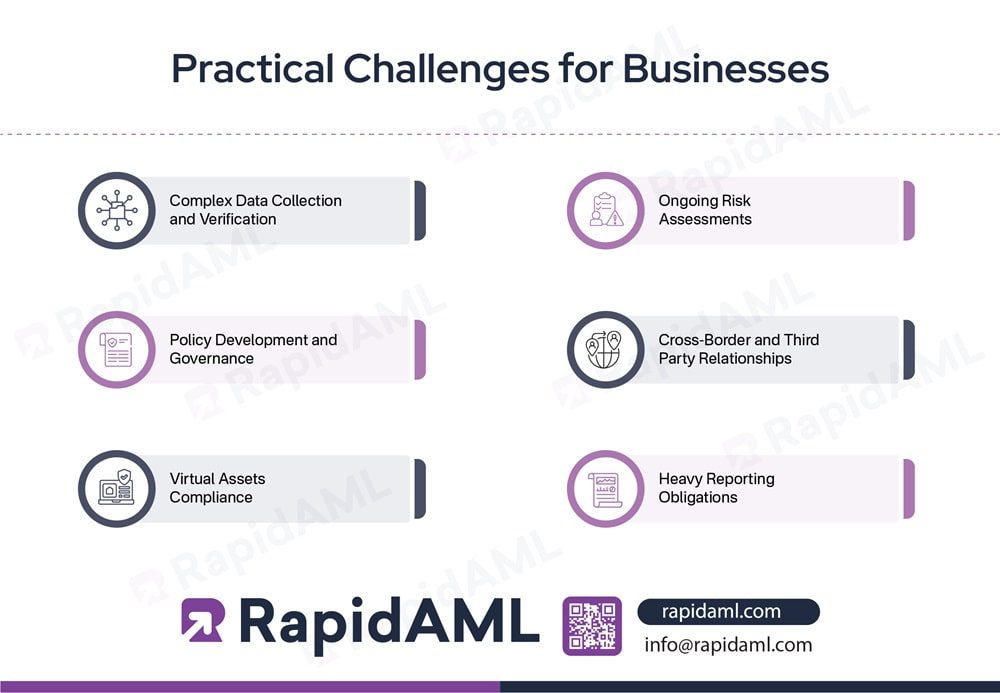 Complex Data Collection and Verification
The rules significantly expand CDD obligations. Entities must gather extensive Know Your Customer (KYC) information for individuals, companies, trusts, and government bodies. Establishing Beneficial Ownership in layered structures is particularly challenging, especially where evidence is incomplete or delayed verification applies.
Ongoing Risk Assessments
Businesses must conduct Continuous Monitoring of Money Laundering or Terrorist Financing and Proliferation Financing Risks across products, delivery channels, and jurisdictions. Independent evaluations and adverse findings require immediate updates, forcing entities to adapt policies rapidly. This level of oversight can overwhelm smaller institutions.
Policy Development and Governance
Comprehensive AML/CTF Programs must address sanctions compliance, employee training, governance oversight, and independent evaluations. Additional requirements, such as senior approval for PEPs, add extra layers of internal control and decision-making complexity.
Cross-Border and Third-Party Relationships
Reliance on third parties for KYC and managing correspondent banking arrangements demands rigorous checks. Businesses must assess whether the foreign entities are compliant with FATF standards, often requiring reassessments every two years. This is resource-intensive and highly technical.
Virtual Assets Compliance
VASPs face unique hurdles, including identifying custodial versus self-hosted wallets, verifying controllers’ licensing, and safeguarding transaction data. The decentralised nature of Virtual Assets makes due diligence especially difficult.
Heavy Reporting Obligations
SMRs, TTRs, and cross-border movement reports require vast amounts of detailed data. The reporting burden increases costs, introduces data-management risks, and exposes businesses to reputational harm if compliance lapses are published.
Australia’s AML/CTF Rules 2025 mark one of the most significant shifts in Australia’s financial crime compliance framework. By introducing detailed CDD requirements, strengthening obligations for VASPs, and embedding international standards such as FATF Recommendations, the Rules aim to modernise the system and close existing regulatory gaps. For businesses, however, these reforms also mean navigating complex operational demands, from extensive data collection and reporting obligations to managing cross-border risks and adapting to new technologies, including the adoption of appropriate AML Software and solutions.
While the transition may prove challenging, requiring investment in systems, training and governance, the long-term benefits lie in greater transparency, improved resilience against financial crime, and stronger international credibility for Australia’s financial sector. The coming years will test how effectively institutions can strike a balance between compliance and efficiency, but Australia’s AML/CTF Rules 2025 undoubtedly set the stage for a more robust and globally aligned AML/CTF Regime in Australia.