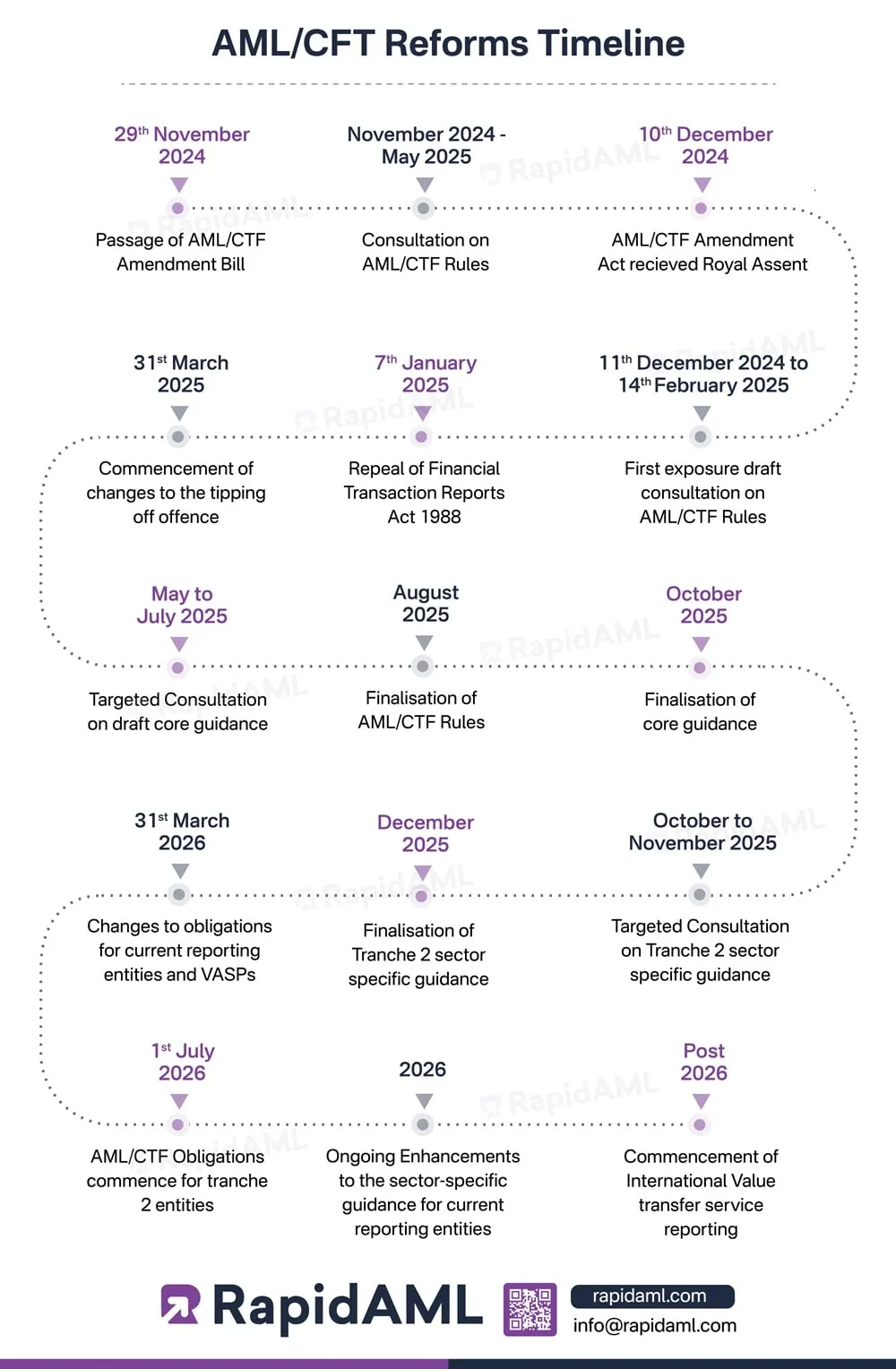
This infographic explains how Australia’s AML/CTF reforms have taken shape. From when the law was passed in 2024 to what’s coming next. It walks you through the key events which occurred and will occur under the reforms concerning the AML/CTF Amendment Act 2024 (Amendment Act). It focuses on AML/CTF Amendment Act 2024 and the Tranche 2 Timeline, which businesses Australia’s Anti Money Laundering framework has entered a new phase. With the Amendment Act in effect, several key events now shape how Tranche 2 entities will need to adjust and be prepared accordingly.
Here’s a clear overview of what has happened so far and what is ahead as part of the Tranche 2 timeline.
On 29th November 2024, the Australian Parliament passed the AML/CTF Amendment Bill and less than two weeks later, on 10th December 2024, it received Royal Assent and officially became the Amendment Act. This marked a significant starting point in the Tranche 2 timeline, initiating a major reform under AML/CTF regulatory mechanism in Australia.
From 11th December 2024 to 14th February 2025, AUSTRAC opened its first round of consultation on the draft AML/CTF rules. This stage of the Tranche 2 timeline provided feedback from industries, including reporting entities, all stakeholders, and industry associations, on how reforms would be implemented practically.
The Financial Reports Act, 1988 was officially repealed on 7th January 2025. This change affected several businesses and entities, including solicitors, traveler’s cheque dealers, and online offshore remitters. These entities were no longer required to comply with the repealed act, although retaining records and disclosure obligations may still apply for past reports.
Following the same, on 31st March 2025, a key update was made concerning the offence of “tipping off”. Under the Tranche 2 timeline, the law will now ask whether the information shared would or could reasonably be expected to prejudice an investigation.
Now, the focus has started shifting towards finalizing the supporting framework to help businesses comply with the new law. From May to July 2025, AUSTRAC conducted targeted consultation sessions with industry associations and peak bodies.
By August 2025, AUSTRAC will officially finalize the AML/CTF Rules, forming a critical pillar of Tranche 2 timeline and laying down legal backbone of the new AML/CTF Regime in Australia.
Following this, in October 2025, the core operational guidelines will also be completed and finalized. This will lay emphasis on how the businesses will be expected to meet their obligations, in a practical risk-based manner.
Between October and November 2025, AUSTRAC will open another round of consultation for Tranche 2 sector-specific guidance in working groups with industry associations and peak bodies.
In December 2025, AUSTRAC will release and finalize Tranche 2 sector-specific guidance. As outlined in the Tranche 2 timeline, this gives businesses six whole months before enforcement and to have both the rules and advice they need, to start implementing things.
Finally, on 1st July 2026, the AML/CTF framework will extend to Tranche 2 entities, including real estate agents, lawyers, conveyancers, trust and company service providers, accountants and dealers in precious stones, metals and products.
Throughout 2026, AUSTRAC will continue working with industry groups to improve and adapt sector-specific guidance. Looking beyond 2026, Australia will also introduce reporting requirements for international value transfer services. This will replace the older framework known as “international funds transfer instruction reporting.”
These key events for the AML/CTF Amendment Act 2024 represent a structured transition into a stronger AML/CTF regime. For existing businesses and Tranche 2 entities falling under the updated framework, these months were not just about watching reforms unfold, but also about actively preparing a new standard of accountability through updated AML Software and solutions.
Navigate The AML/CTF Reform Roadmap
Get Ready for the Day When AML/CTF Obligations Kick in for Tranche 2 Entities
Get Started
Contact Us