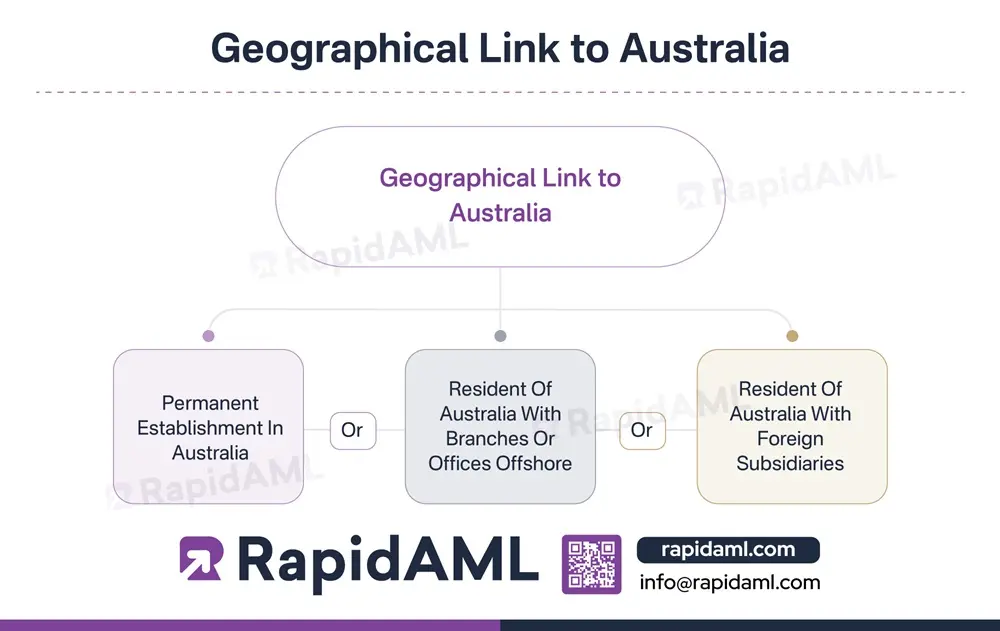
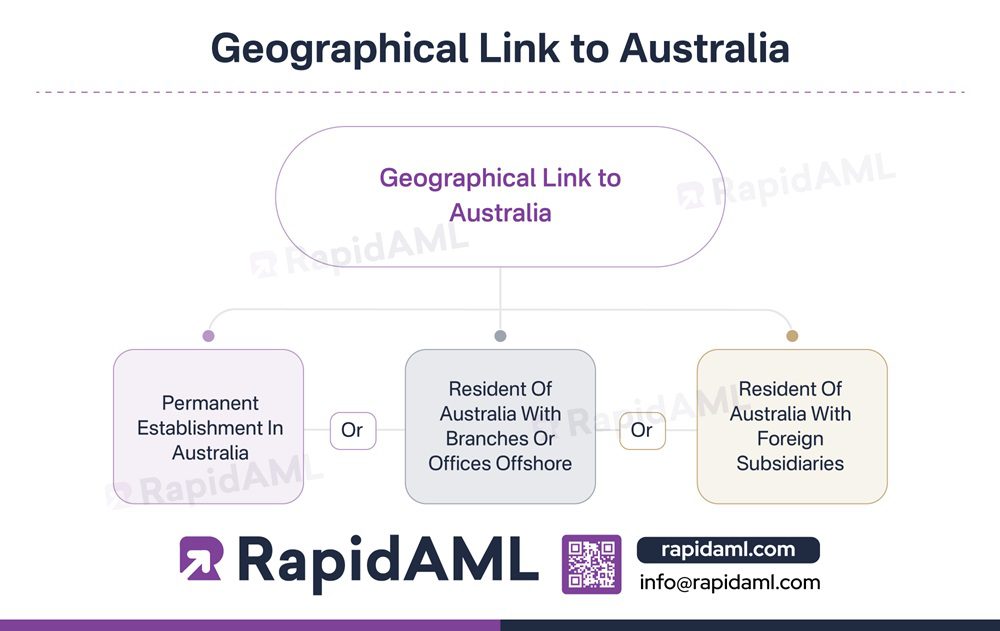
This infographic explains what a Geographical Link means, how it’s defined under the Anti-Money Laundering and Counter-Terrorism Financing Act 2006 (AML/CTF Act) and the different ways a business could fall under AUSTRAC’s reporting obligations, even if it operates from overseas.
If an entity offers financial or professional services, it might be legally required to follow Australia’s AML/CTF laws. Under the AML/CTF Act, a business may come under the umbrella of being a Reporting Entity if it provides designated services and it has a Geographical Link to Australia. This can arise in any one of the several ways, including:
Amongst these three ways, a business will be considered to have a Geographical Link with Australia if it offers services in either one of these ways. Let’s discuss them in detail.
In simple terms, if you regularly carry out activities and business from a fixed location, that would be considered a permanent establishment. This includes offices, branches, or even an agent acting on your behalf. It can have more than one permanent location.
A person or a business will be treated as having a permanent establishment in Australia if:
Having a permanent establishment in Australia is just one way to meet AUSTRAC’s Geographical Link test. Another way is when you are an Australian resident, but you operate through branches of offices located overseas.
The Geographical Link test is not limited to having a physical presence in Australia. Being an Australian resident with business branches or offices overseas can also bring you under AUSTRAC’s rules. Let’s discuss what makes you an Australian resident for the Geographical Link requirement.
Individuals
An individual will be treated as an “ordinarily resident” if they live in Australia with a certain level of permanence and not if they’re just visiting temporarily.
Company
A company would be considered a resident of Australia if:
Trust
A trust is considered resident of Australia if any of the following applies:
Partnerships
If even one partner is a resident of Australia, the partnership will be treated as Australian.
Corporation Sole or Body Politic
Corporations sole or bodies politic are automatically considered Australian residents if they’re established in Australia or governed by Australian law.
Your company might not be based in Australia, but if your parent company is an Australian resident, and you provide services overseas through a permanent establishment, you still fall under AML/CTF Obligations.
There’s one major exception to the rules above.
If you are a remittance network provider (money transfer businesses) in Australia, you would automatically be considered a Reporting Entity under the AML/CTF Act. This is applicable even if you don’t meet the Geographical Link requirement or have a permanent establishment in Australia.
Key Takeaway
Meeting the Geographical Link requirement under the AML/CTF Act can happen in different ways, through having a permanent establishment in Australia, being considered an Australian resident while operating overseas, or falling under specific exceptions like those for remittance network providers. Incorporating appropriate AML Software and solutions within these operating structures further supports compliance by helping entities maintain visibility and control over activities connected to Australia.
Each pathway ensures that businesses and individuals with meaningful connections to Australia remain accountable for preventing Money Laundering and Terrorism Financing.
Know What Your Geographical Exposure Is
Find Out If Your Business Falls Under Australia’s AML/CTF Rules
Get Started
Contact Us