
The Auditors and Independent Accountants in the UAE are recommended to use Name Screening software that assists in determining if the customer, whether a natural person or a legal entity, their UBOs, or senior management are listed under the Sanctions Lists – UNSC Consolidated List, UAE Local Terrorist List, or other globally-accepted sanctions or watchlists
Additionally, the name screening software also enables auditors and independent accountants in the UAE to identify if any customer is classified as a Politically Exposed Person (PEP) or has been involved or alleged to be involved in any fraud, financial crime, tax evasion by reviewing the customer’s adverse or negative media and social media.
The name screening software is also referred to as Sanctions Screening Software, which has the capability of screening a customer for PEP, Adverse media, social media, and sanctions list checks.
While evaluating the risks posed by any potential or existing customer, the auditors and independent accountants in the UAE are recommended to conduct a screening to cross-check the names to identify sanctions, PEP, adverse or negative media. These lists are not limited to the regional or national level but are extended to international watchlists.
The name screening process should be performed by auditors and independent accountants in UAE when:
Audit the Books and the Names Too
Make Sure Your Client Doesn’t Hide a Compliance Risk
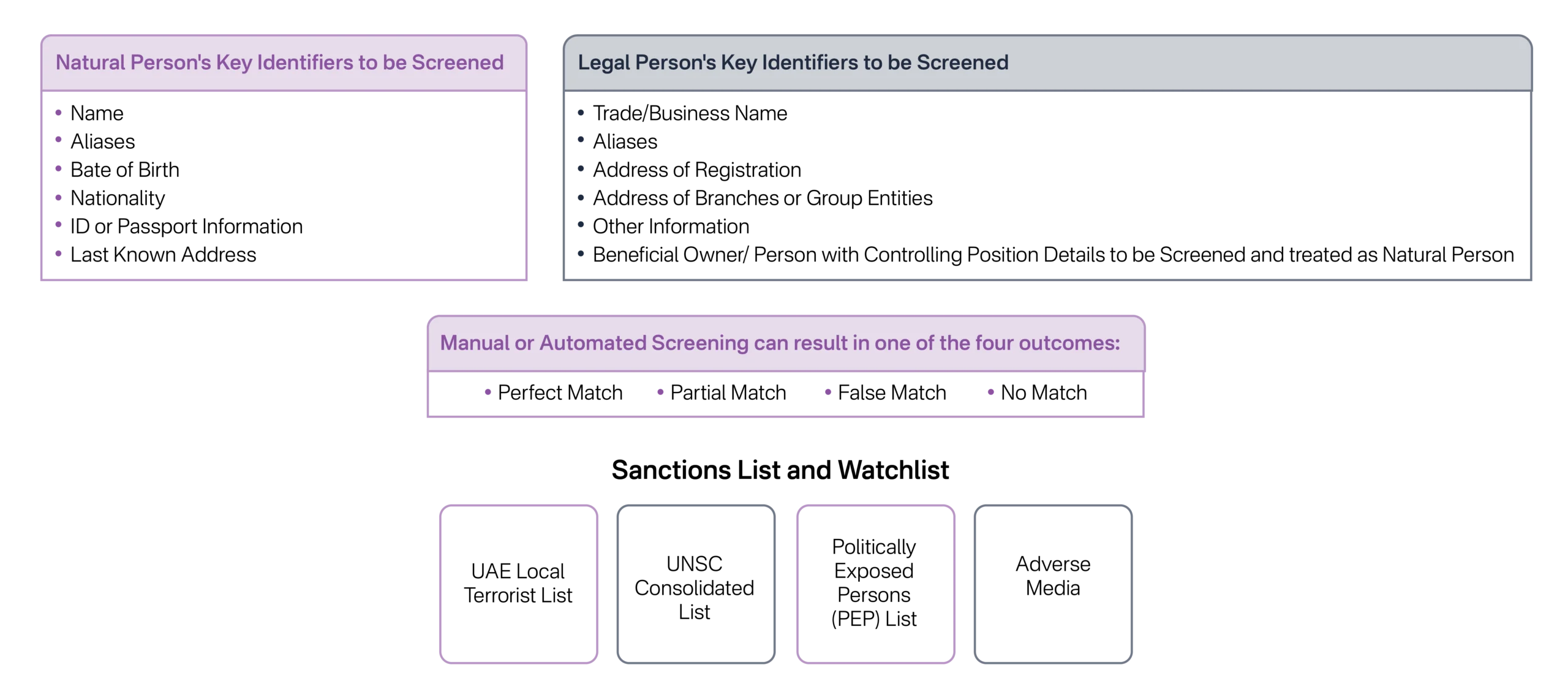
Name Screening can be broadly classified into three categories: Sanctions screening, PEP screening, and Adverse media screening. Let’s dive into each category for a better understanding.
Refer to our YouTube Video: Introduction to Name Screening: The UAE Standpoint | RapidAML
Purpose: Sanctions Screening serves the following purposes:
The auditors and independent accountants in UAE must ensure that they perform a screening of customers (existing or potential, including UBOs, shareholders, or persons exercising management control) against the Sanctions list to identify if any of their customers are designated or sanctioned individuals or entities, so that appropriate freezing and reporting measures can be taken.
TFS Compliance: Cabinet Decision No. 74 of 2020 provides for TFS Compliance by registering on the UAE Executive Office for Control and Non-Proliferation (EOCN) Website and screening the TCSP’s prospective or existing customers, suppliers, or business associates.
For more insights into Sanctions and TFS Compliance Requirements in UAE, refer to Sanctions Compliance Best Practices for DNFBPs and VASPs.
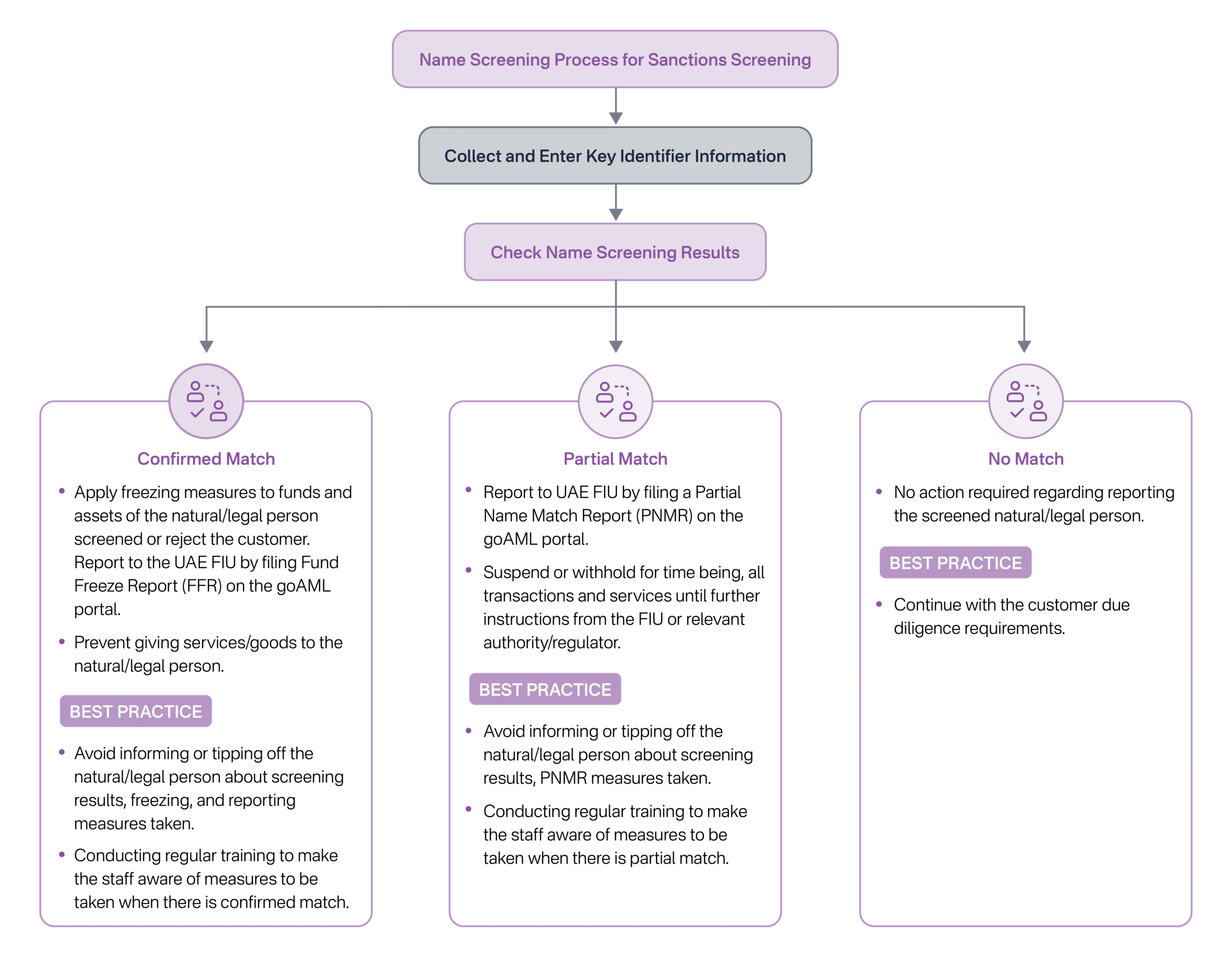
Process: The Sanctions screening for auditors and independent accountants is illustrated below for visual clarity.
Refer to our YouTube Video: The orderly process of customer screening to ensure AML compliance | RapidAML
Purpose
UAE’s AML/CFT laws and Supplemental Guidance for Auditors require accounting professionals in the UAE to perform screening to identify PEPs. This process is followed to rule out the possibility of a natural person as a customer, any of the UBOs, shareholders, or authorised signatories of a legal entity:
The auditors and independent accountants must scan or screen the customer to understand:
To conduct an effective risk-centred Customer Risk Assessment (CRA), identifying Politically Exposed Persons (PEPs) plays a vital role. This process not only assists in the accurate allocation of risk scores or ratings, but it also ensures that Enhanced Due Diligence measures are implemented effectively. This approach adequately aligns with the risk ratings assigned to money laundering, financing of terrorism, or proliferation financing (ML/FT or PF).
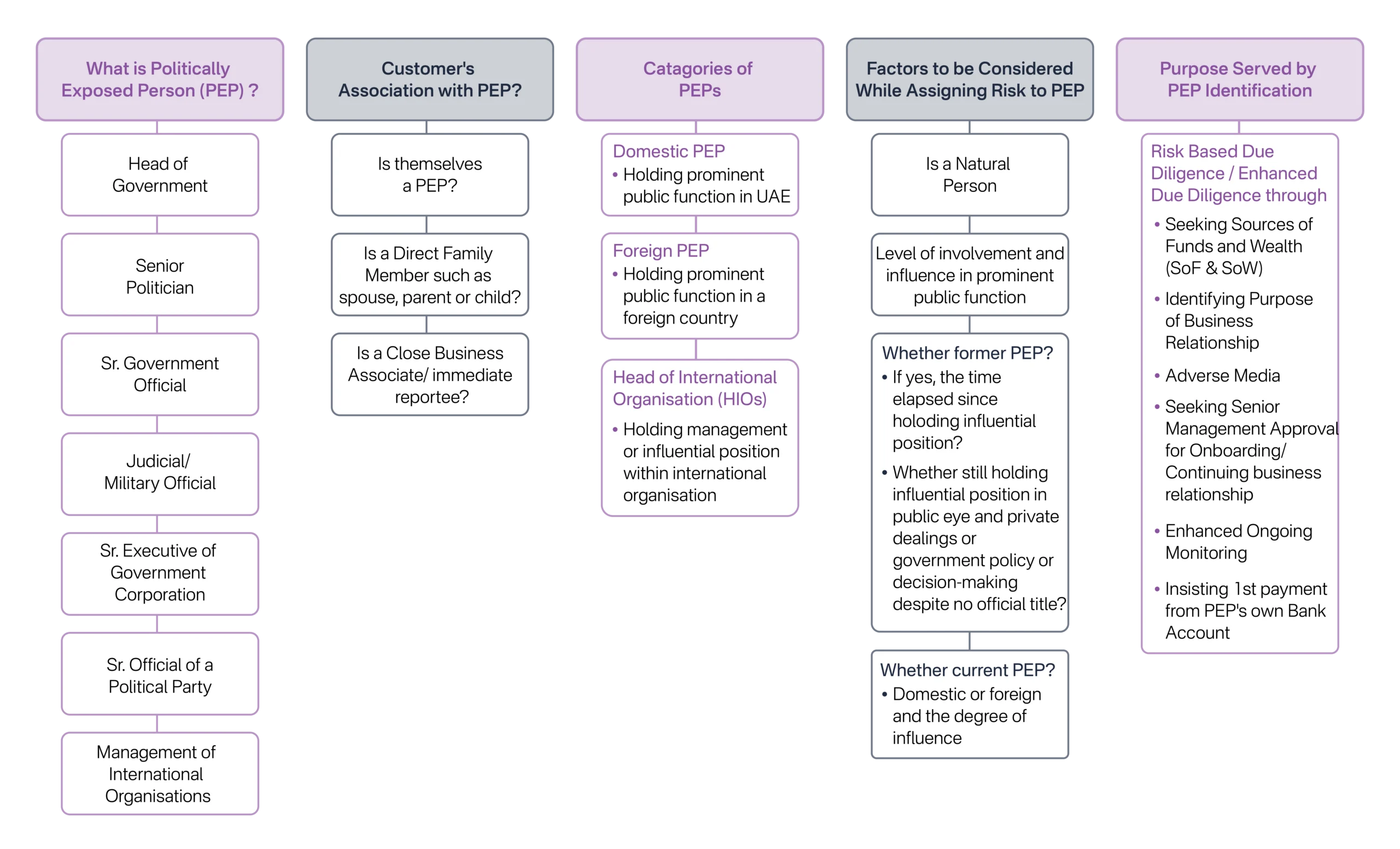
Process: The PEP screening process for auditors and independent accountants in UAE is illustrated here for visual clarity.

Purpose
Adverse Media Screening comes into play when auditors and independent accountants want to extract relevant details about potential or existing customers from publicly available information, to assess their potential involvement in money laundering, illegal activities or any predicate offenses, that potentially did not get caught in the radar for sanctions screening or PEP watchlists.
For simpler understanding, Adverse Media Screening plays a crucial role in identifying ML and predicate offence risk areas that might not be covered in sanctions screening or the KYC declaration or questionnaire.
Take a look at the illustration below to know how Adverse Media acknowledges and aids in mitigating ML/FT and PF risks.

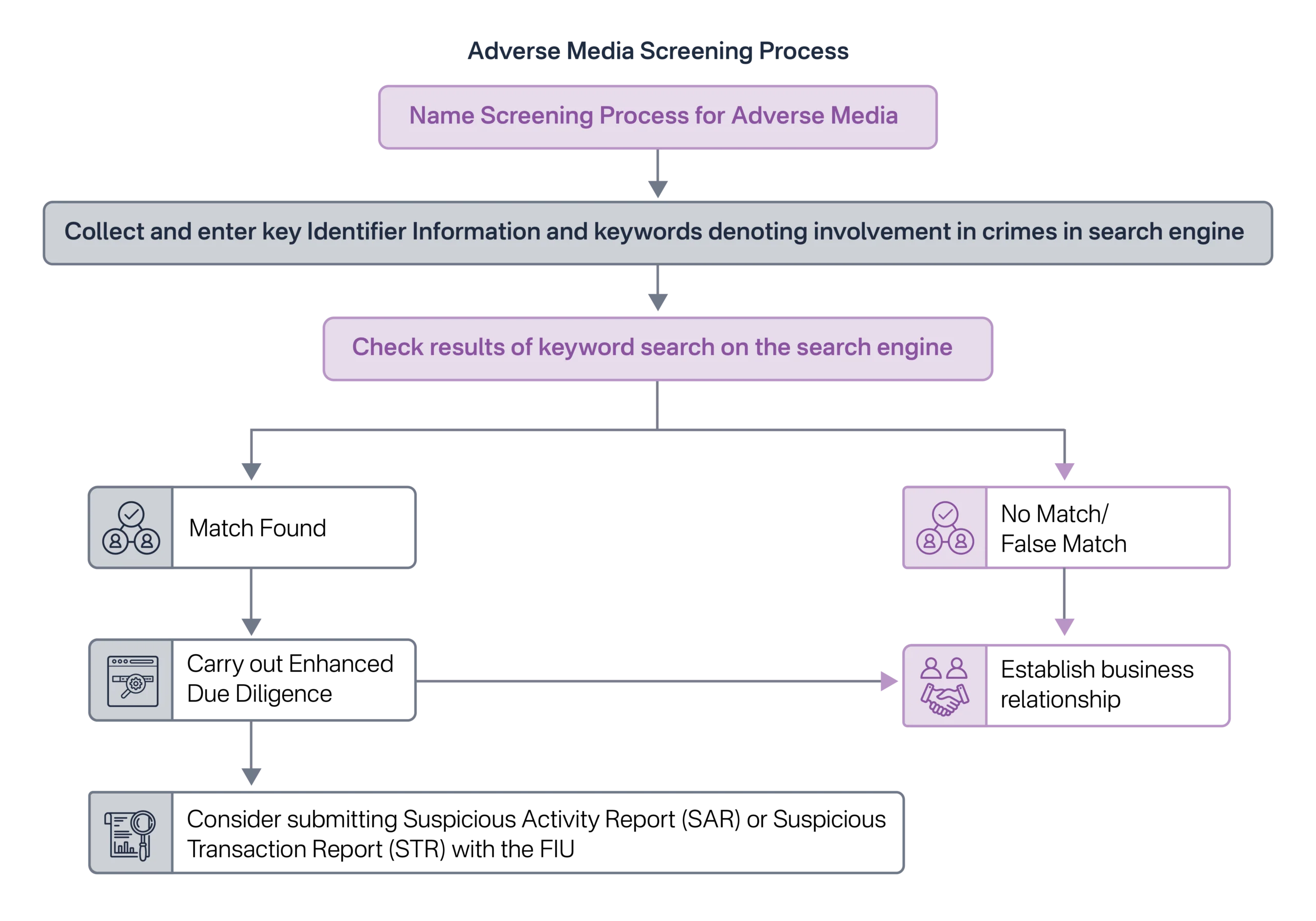
Process: The illustration below aids in understanding the Adverse Media screening process.
For more insights into Adverse Media, refer to Integrating Adverse Media Screening into AML Framework: A Guide for DNFBPs and VASPs
Refer to our YouTube Videos:
Take a glance at the compliance requirements depicted in the infographic on the Name Screening Software Process flow for Auditors and Independent Accountants in UAE, to understand the importance of effective screening for accounting professionals. The following factors state how effective Name Screening is a non-negotiable AML/CFT and TFS Compliance requirement:

1. Improved AML/CFT and Sanctions Compliance
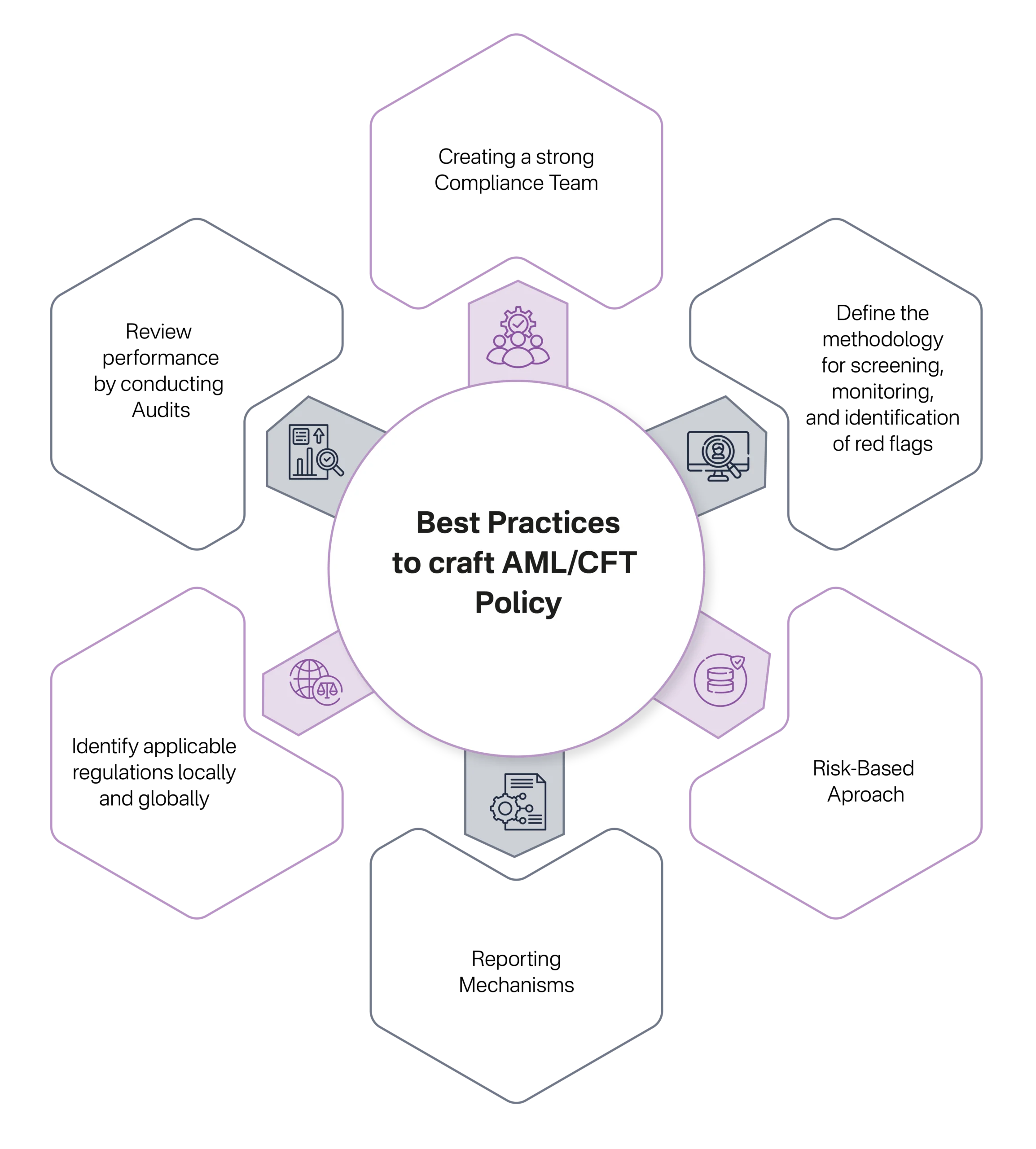
A fully functional Name Screening tool works wonders for auditors and independent accountants, as it helps accounting professionals comply with AML/CFT and TFS or Sanctions Compliance policies and maintains a check on appropriate measures. The name screening solutions serve as a flagging tool to keep sanctioned individuals or entities under scrutiny for better tracking.
How AML/CFT and TFS or Sanctions Compliance Policies, Procedures, and Controls Help Auditors and Independent Accountants with Effective Screening
2. Improved CDD Accuracy
Customer Due Diligence (CDD) enables auditors and independent accountants to identify and verify the information of potential customers, to safeguard themselves against potential financial crime risks.
The effectiveness of a screening process has a direct impact on the quality-oriented CDD results. To steer clear of the catastrophic domino effect, accounting professionals must incorporate a streamlined and accurate screening process. The CDD process comprises five (5) steps, such as:
1. Know Your Customer
2. Name Screening
3. Customer Risk Assessment (CRA)
4. Enhanced Due Diligence (EDD)
5. Ongoing Monitoring
One of the most care-prone zones of the CDD process is Name Screening, and below are the elements that can contribute to an erroneous name screening result:
An inaccurate Name Screening result can have a ripple effect on subsequent CDD process steps, such as CRA, EDD, and the effectiveness of Ongoing Monitoring, making the entire process invalid and erroneous.
To further understand what is at stake due to inaccurate Name Screening results, it is necessary to understand the error-prone zones in the subsequent steps of the CDD process. The Name Screening results received by any AML Risk Analyst would differ if the customer risk were incorrectly assigned during the CRA process, and as a result, EDD may either be wrongly applied to low-risk customers instead of high-risk customers.
It is crucial to have a well-tested, integrated, and effective Name Screening process in place to avoid any errors in CDD accuracy and quality.
3. Improved Customer Risk Assessment (CRA)
After Name Screening, to progress further in the CDD process, the next step for auditors and independent accountants is to perform Customer Risk Assessment. In CRA, the potential customer is assigned an appropriate risk rating or scoring based on several factors, including screening results, the purpose, nature, frequency, and associated ML/FT and PF risks with the proposed business relationship.
An inaccurate name screening result has a significant impact on the risk rating of a customer, as elaborated earlier. To avoid any such mishaps and to achieve quality CRA results, the Name Screening process must be accurate and error-free.
4. Timely Regulatory Reporting Obligation of Auditors and Independent Accountants
To ensure compliance with the TFS obligations, Auditors and Independent Accountants must follow the four steps:
Regulatory Reporting Obligations for Auditors and Independent Accountants in UAE

Additionally, if the accounting professional observes any suspicious activity or behaviour, a Suspicious Activity Report (SAR) needs to be filed. In the event of any suspicious transaction or series of transactions, the accounting professional should file a Suspicious Transaction Report (STR) to flag out ML/FT or PF indicators.
5. Improved Customer Experience
Across any business, it is widely acknowledged that ‘the better the customer experience, the better customer loyalty and retention.’ To provide a seamless and hassle-free customer onboarding experience, it relies entirely on an efficient sanctions screening software with an in-built KYC tool to store and maintain customer information, thereby delivering a better customer experience.
6. Accurate and Timely Workflow Escalation
Efficient Name Screening facilitates immediate disambiguation, allowing Screening Analysts to escalate the case to the KYC Analyst, the AML Risk Analyst, or the Compliance Officer as needed. Overall, the AML compliance workflow of the accounting professionals is accelerated and improved due to the efficient name screening process.
Implementing the Name Screening process presents its own set of challenges. A few commonly faced pain points are mentioned below:
1. Cost Constraints
For any small or large accounting or auditing professional, one of the primary concerns when implementing a name screening software is its cost-effectiveness. Screening software usually charges its users with each screening, which poses a problem when new or untrained staff attempt to screen, as they might screen the customer by entering incorrect details, causing software to charge while compliance obligations remain incomplete and incorrect. Also, the subscription to name screening software, assigning employees to use such software, and training them to use the name screening software accurately, adds to the cost burden.
2. Ongoing Monitoring Difficulties
Ongoing monitoring requires auditors and independent accountants to perform regular interval checks on existing business relationships, update the status based on the findings of name screening software, till the completion or cessation of the relationship. It is crucial for auditors and independent accountants to understand the importance of accurate and timely updates to various sanctions lists, failing which the monitoring results can be inaccurate or irrelevant.
3. False Positives and Negatives
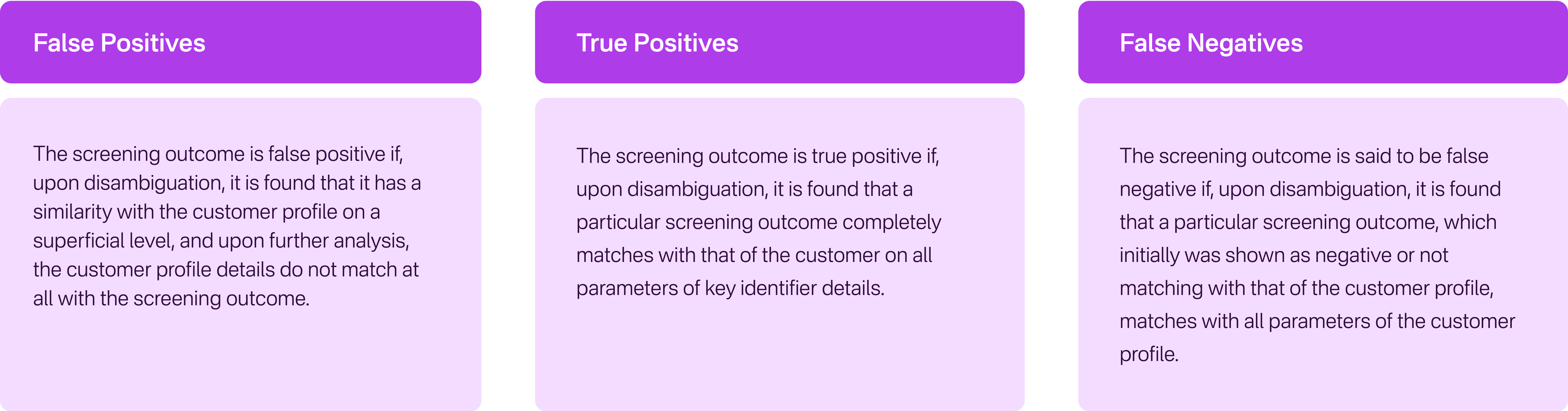
False Positives refer to matches generated by screening software due to some level of similarity with the prospective customer’s profile details, which, upon disambiguation, are categorised as false positives because the details of these matches do not match the details of the prospective customer’s profile.
False Negatives refer to matches that, upon disambiguation, are identified to have been falsely categorised as negative results.
Causes of False Positives in Name Screening by Auditors and Independent Accountants

The issue of false positives is detrimental to effective name screening, as it consumes the analyst's unnecessary time disambiguating many false positives that could have been avoided or eliminated if the name screening solution had been well-calibrated. False positives drain accounting professionals’ resources and time.
4. Data Quality Issues
For an accounting professional, collecting, maintaining, and retaining customer data in an accurate format can be a tedious task. On top of that, the data quality is compromised in the form of inaccuracy or inadequacy of information, or inconsistency or mismanaged format, which can make the task more difficult than it should be. If an auditor or independent accountant enters customer data that is inaccurate or has inconsistent formatting, the Name Screening software will provide substandard outcomes and raise questions on the screening accuracy.
5. Integration Issues
A fancy technical term like ‘integration issues’ can wreak havoc for auditors and independent accountants during the Name Screening process. Integration issues generally arise due to technical difficulties, compatibility issues, redundant or legacy systems, leading to a lack of scalability, flexibility, and licensing permission issues. Due to such occurrences, auditors and independent accountants are unable to use the tool to its optimal capacity.
6. Multi-Jurisdictional Compliance
Accounting professionals face the challenge of ensuring multi-jurisdictional AML/CFT compliance, particularly when the scope of their services and client requirements extend beyond a single jurisdiction. In situations where an auditor or independent accountant has a multi-jurisdictional presence or client base, it is necessary to consider multiple sanctions and watchlists and ensure compliance with local and international TFS requirements.
Tired of Screening the Same Name 30 Times?
Explore Ways to Reduce False Positives and Reclaim Your Time
While attempting to understand and analyse a process, the first step is to identify the pain points, and the next step is to have an overview of the consequences or the intensity of impact it will have on the business.
The Auditors and Independent Accountants must follow the same approach to understand the Name Screening challenges and their impact on their day-to-day functions.
Consequences Due to False Positives
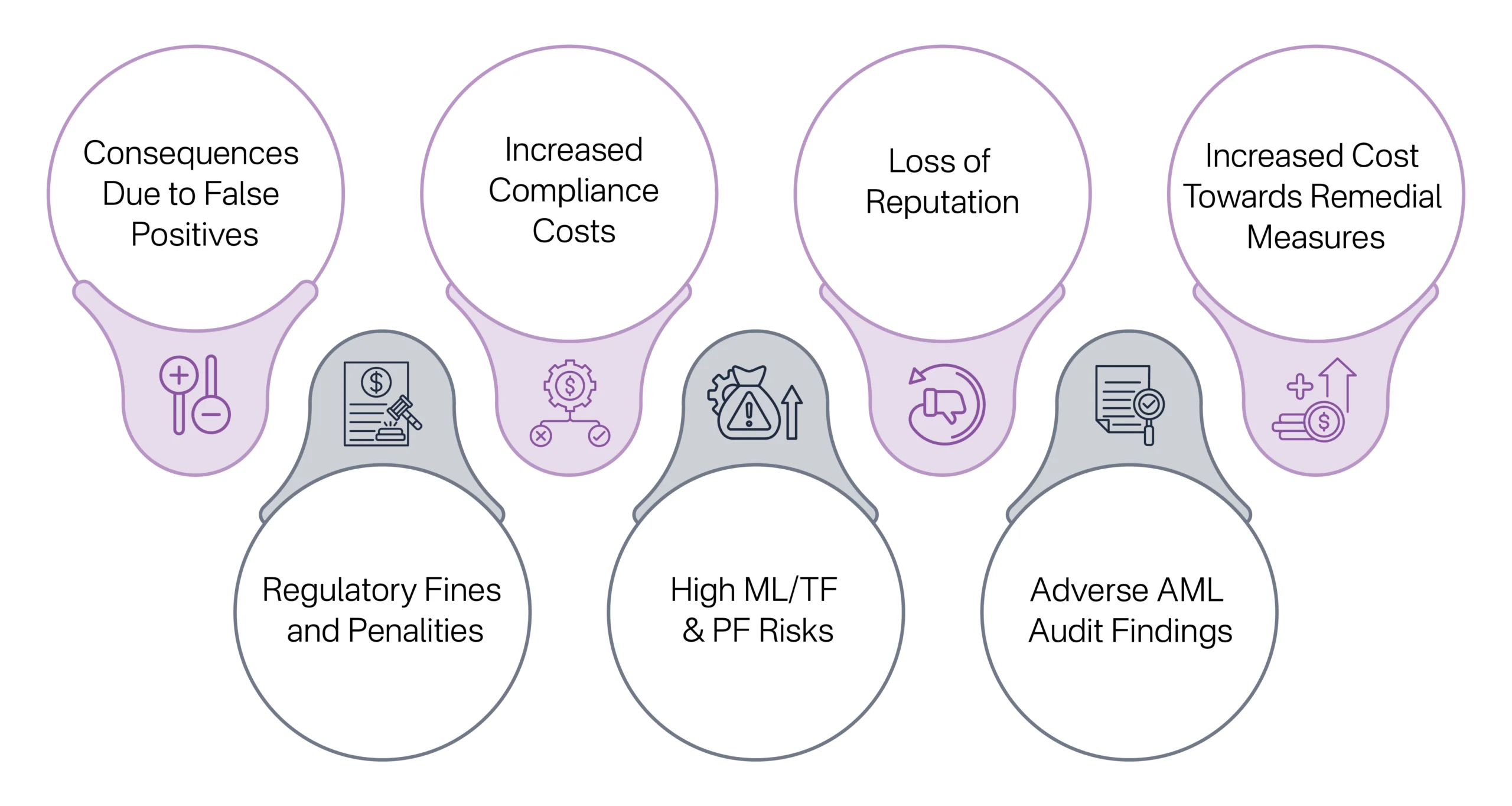
The pain point of false positives comes with its own set of resultant consequences. Accounting professionals, when dealing with a high number of false positives, must also deal with the following:
Consequences of High False Positive Rates on Auditors and Independent Accountants during Sanctions Screening Outcome Analysis

Regulatory Fines and Penalties
Considering the challenges faced by auditors and independent accountants day in and day out, an ineffective and inefficient screening process may expose these accounting professionals to even greater risks.
Risks include non-compliance with AML/CFT and TFS regulations, security and data privacy issues, and the ability to effectively manage multi-jurisdictional policies and procedures. All these risks can snowball into an accounting professional facing regulatory fines and penalties due to breach or violation.
Loss of Business Reputation
A single misstep and everything is at stake for an auditor or independent accountant, as they are unable to comply with AML/CFT regulations, unable to timely identify threats and safeguard customers or themselves, and face consequences due to poor data quality or inaccuracy.
The issues mentioned above can lead to reputational damage, loss of business, and loss of trust amongst customers.
High ML/TF & PF Risks
Acknowledging the fact that an inaccurate name screening process may directly pose higher ML/TF and PF risks is like calling a spade a spade. Accounting professionals must consider technical implementation issues when identifying residual risk and testing control efficiency.
Increased Compliance Costs
An increase in compliance costs can result from one or many issues faced by an auditor and independent accountant. The elements of false positives and negatives, poor data quality, and integration issues may lead to an increase in AML/CFT and TFS compliance costs.
The smooth and seamless handling of multi-jurisdictional compliance is a far-fetched thought for some AML Compliance Officer/MLRO, due to inefficient or ineffective resources.
Adverse AML Audit Findings
Multiple challenges in name screening leads to AML Audit’s observations and findings being unfavourable due to gaps and issues in name screening. The adverse AML Audit findings ultimately lead to huge costs in attempt to remedy such issues.
Increased Costs Towards Remedial Measures
Instances such as adverse AML Audit findings, increased number of false positives, delayed onboarding, and the likes require accounting professionals to take measures to ensure that these lapses do not occur in future and negative implications are adequately mitigated, which ultimately costs them.
False Positives Drain Time and Your Team’s Patience
Operational Lag Leads to Reputational Drag
Understanding the pain points and challenges faced by auditors and independent accountants, RapidAML can significantly help bridge the gaps and serve as a shield against the consequences of screening problems.
RapidAML simplifies Name Screening Obligations for auditors and independent accountants in UAE through its multi-faceted capabilities, such as the following:
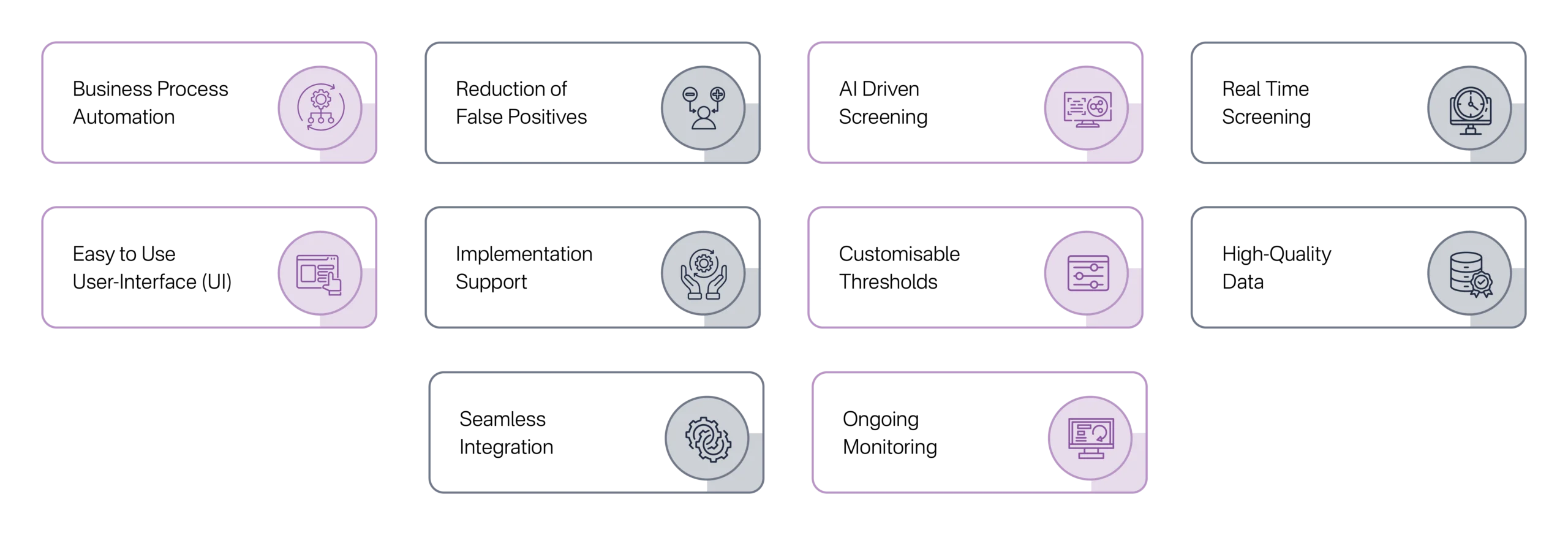
Business Process Automation
Any task or process performed in a standard pattern that consumes more time, manual efforts, and resources can be replicated by implementing automation. Automation is a key to an optimised business world, setting aside tedious and repetitive tasks. Name Screening is one such process where the implementation of automation can help achieve faster screening, better efficiency, and accurate results. RapidAML’s Screening Software is beneficial for auditors and independent accountants, as it offers seamless automation functionality to conduct name screening for both potential and existing customers.
Real-Time Screening
Auditors and independent accountants, given the nature of their services and responsibilities, cannot afford to work with outdated and irrelevant information. It is crucial for accounting professionals in the UAE to have real-time, updated information to perform accurate and efficient screening without missing potential matches. RapidAML, with its state-of-the-art technology, provides the latest screening lists that update automatically in real-time, enabling smooth assistance in the screening process at lightning speed.
High-Quality Data
RapidAML generates top-notch data in terms of screening results, screening registers, and case registers. The high-quality data generated helps comply with record-keeping requirements and is interlinked with the document repository feature of RapidAML, facilitating easy retrieval of required information in just a few clicks. The high-quality data also helps the AML Compliance Officer or the MLRO in decision-making due to its high accuracy, which is devoid of human errors.
Reduction in False Positives
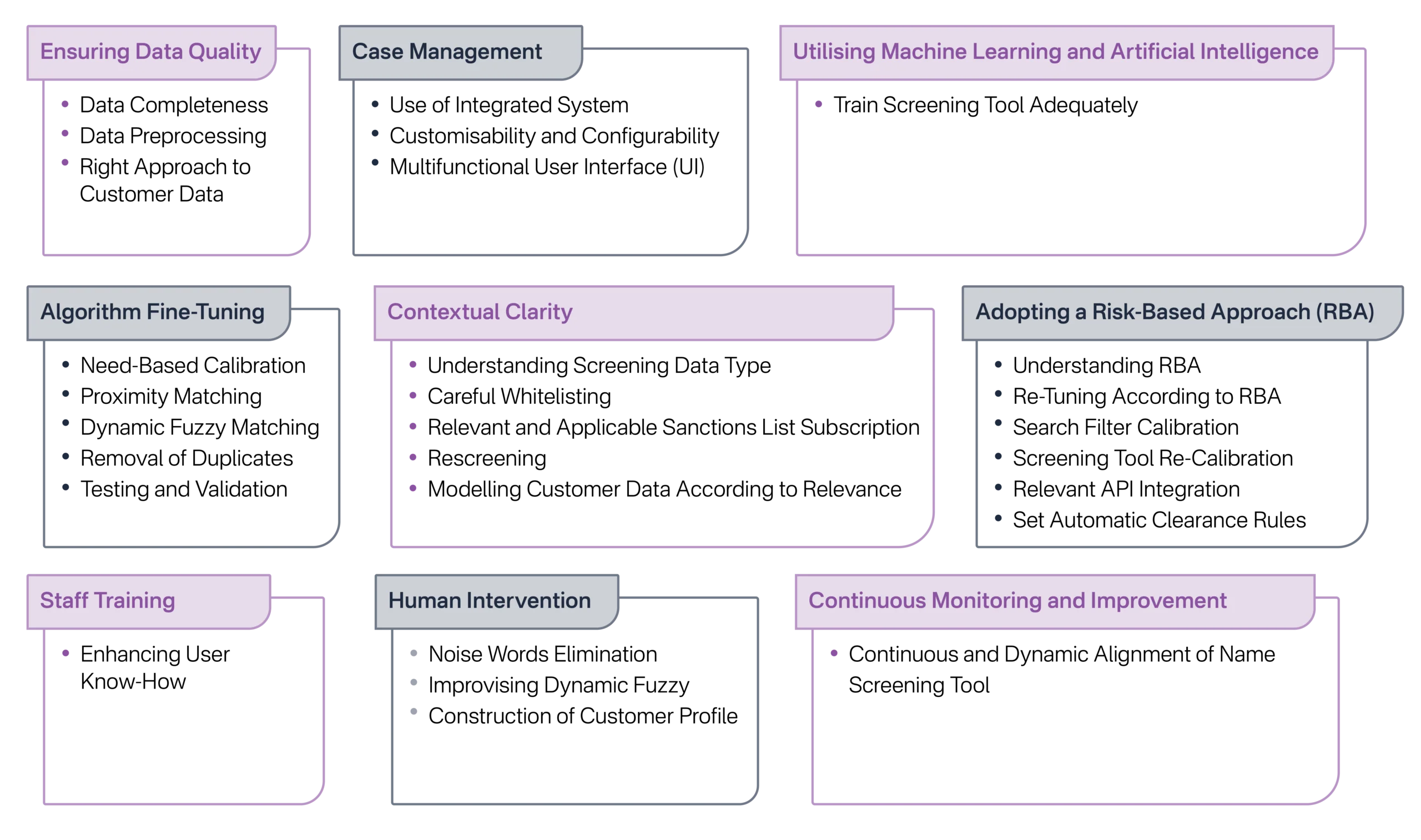
One of the major challenges faced by auditors and independent accountants in the UAE is the occurrence of false positives. RapidAML’s fuzzy logic-infused solution offers customisation functionality that targets the reduction of false positives. The infographic below summarises how RapidAML Screening Software caters to accounting professionals in reducing instances of false positives.
How RapidAML Helps Auditors and Independent Accountants Minimise False Positives
Refer to our YouTube Video: Effective Approaches to Reducing False Positives in Sanctions Screening | RapidAML
AI-Driven Screening
RapidAML, with its AI-powered fuzzy matching, enables accounting professionals to avoid getting lost in a haystack while searching for a needle. The AI-driven screening function reduces time spent disambiguating false positives, enabling faster decision-making.
Batch Screening
If any software automates repetitive tasks but requires the accounting professionals to perform screening for one customer at a time, then the software is asking for more and delivering less. RapidAML believes that time is money and facilitates bulk screening. Once the bulk screening is completed, the screening analyst is given the ability to disambiguate each result individually, serving compliance purposes while streamlining the screening process.
Easy-to-Use User Interface (UI)
If the UI of any software is not user-friendly or difficult to navigate, the software’s purpose is defeated there and then. RapidAML’s intuitive Screening UI is easy to understand, simplifying the screening process for accounting professionals in the UAE.
Ongoing Monitoring
AML compliance is not a one-time task - it is not about ‘out of sight, out of mind’ and requires continuous monitoring throughout the customer relationship. RapidAML enables AML Compliance Officers to classify customer profiles as accept, reject, inactive, dormant, or exit, thereby initiating ongoing customer monitoring based on the compliance team's decisions. When the system identifies matches or inconsistencies in customer profiles, it triggers alerts when the information matches with over 700+ global watchlists, PEP lists, and adverse media.
KANBAN Board for Task Management
The Name Screening process requires the involvement of several personnel with different profiles. From front office staff for customer document collection and data entry to screening analysts for conducting and disambiguating screening outcomes, and final escalation to the AML Compliance Officer for the purpose of determining whether regulatory reporting is required or disambiguating is done correctly or not. The progress and assignments of all these activities across the team are easily accessible and viewable on the Kanban Board.
Seamless Integration
Having software with dream-like integration functionality, which collaborates with other software and tools, connects seamlessly, and on top of that, enables smooth data exchange. That’s RapidAML for you! Working with various platforms like CRM, POS, customer onboarding, and billing tools simplifies business processes and shuns away the hurdles faced by accounting professionals.
Implementation Support
RapidAML will never leave side when the going gets tough for auditors and accounting professionals. It will take the worries away with its seamless and smooth support functionality, which believes in lending a hand and fostering self-reliance. Auditors and independent accountants can participate in training sessions on the screening process, report generation, a smooth onboarding process, and more.
Customisable Thresholds
RapidAML caters to every want and need of an accounting professional! With its customisation function, auditors and independent accountants can determine the threshold for results to be generated. RapidAML facilitates customising watchlists, criteria, and thresholds for generating screening results.
Easy Disambiguation
RapidAML Screening software facilitates screening match disambiguation by generating screening outcomes that are already categorised, such as Sanctions, PEP, and Adverse Media. This makes it simpler for the screening analyst to identify whether the match is false, partial, or complete.
Document Repository
RapidAML enables users to retain records of their prospects and customers’ screening processes, their screening results, and documents uploaded for the duration required by auditors and independent accountants’ supervisory authorities to fulfil the record-keeping requirements, thus serving as an on-cloud document repository.
Why Chase Red Flags When You Can Filter Them Intelligently
Streamline Compliance into Your Core Workflow
RapidAML Screening Software, with its advanced technology, helps keep an eagle-eye view while performing name screening, working hand-in-hand with the UAE’s AML/CFT and TFS obligations applicable to auditors and independent accountants. The name screening tool helps accounting professionals identify and mitigate any ML/FT and PF risks, eliminating any pain points or challenges they may face.
For a better understanding, take a look at the distinct features of RapidAML that help resolve screening issues faced by auditors and independent accountants in the UAE.

AML That Fits Your Process
We Adapt to Your Operation without Breaking Your Operations
To master name screening software like a pro, auditors and independent accountants must showcase precision, adhere to compliance, and execute seamlessly, all while being within the boundaries of regulatory requirements.
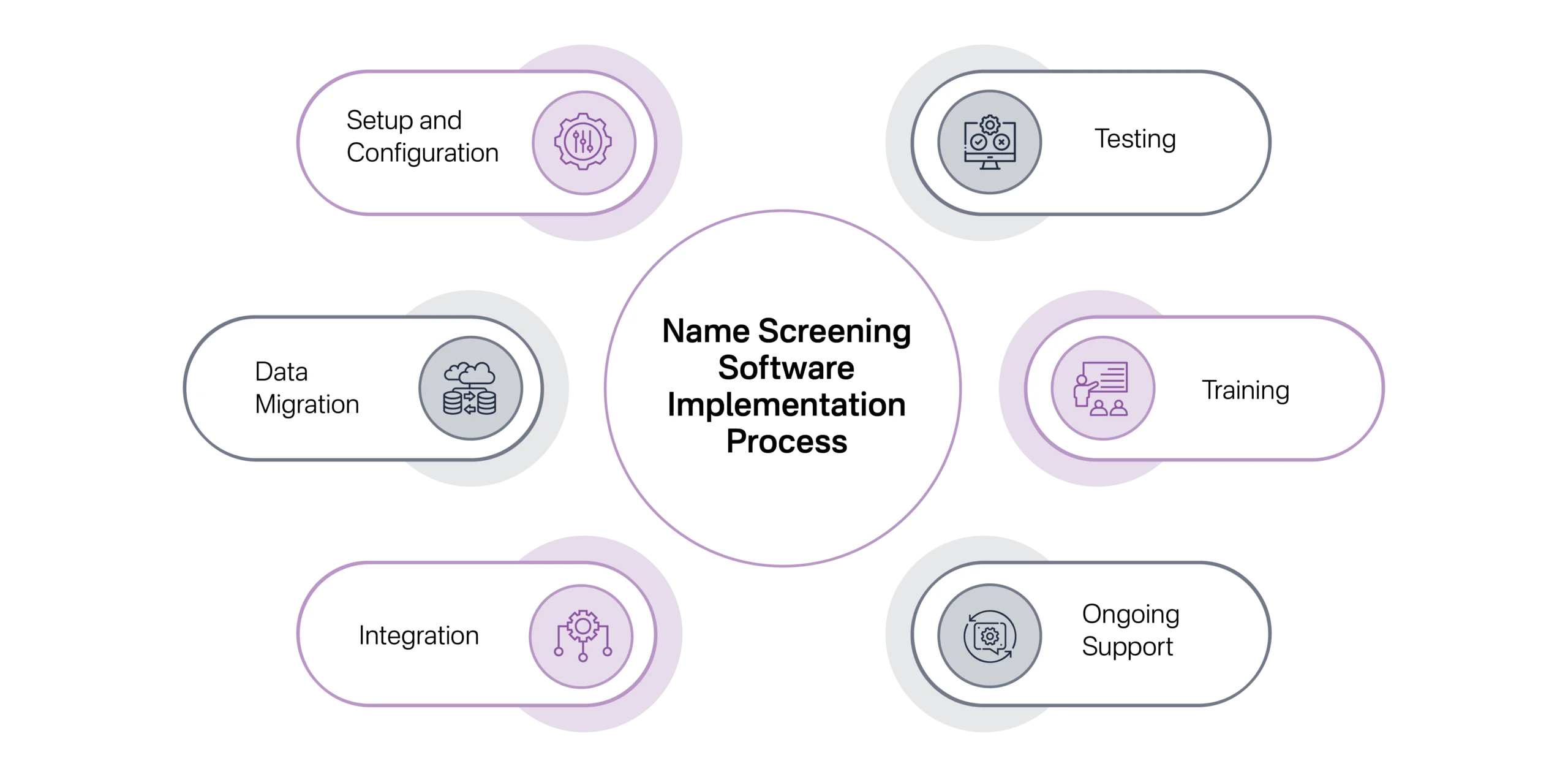
To take a path for the efficient yet successful implementation of screening software, the best practices to follow are:

Screening Software Requirements Identification
Identify Migration Requirements
Select, Test, and Fine-Tune Name Screening Software
Allocate Adequate Resources
Name screening is not just a safeguard measure but a mandatory compliance requirement for auditors and independent accountants. Rather than facing hefty fines, suspension, or cancellation of business license, and even imprisonment, investing in software that safeguards accounting professionals against vulnerability to risk is a precautionary expense.
Accounting professionals, while ensuring long-term efficiency, must assess the cost-benefit ratio and select a name screening software that minimises risks and manual intervention with better migration functions.
Define Users and their Roles
Auditors and independent accountants who clearly define the capabilities of each user, outline a hierarchy escalation matrix, and accurately map workflows, make the name screening software work efficiently for them.
To achieve the smooth implementation of defining users and their roles, accounting professionals can reach out to vendor support for assistance in a seamless transition and bridge any gaps through training and awareness sessions.
Configure Alerts, Workflows, and Timelines
Configuring alerts, notifications, and task completion timelines is an action item for auditors and independent accountants, which, when combined with an efficient screening software, can help accounting professionals achieve name-screening compliance excellence.
Integrate Name Screening Software
Integration functionality in a name screening software helps accounting professionals minimise operational costs and reduce overlapping efforts. Integration can be done with CRM, accounting, invoicing, and other AML software, including transaction monitoring, customer risk assessment, customer due diligence, etc.
Case management is one such software that auditors and independent accountants must consider when attempting to unify integrated solutions under a single dashboard.
Assessment of Post-Implementation Outcomes
Auditors and independent accountants must continuously assess the post-implementation outcomes to analyse the cause of the success or failure of the name screening software. This helps ensure alignment with organisational goals for compliance at all times. If there are any deviations, it suggests screening failure, increased instances of false positives, and an unending disambiguation workload for screening analysts, requiring remedial measures such as reconfiguration, retraining, or a change in screening software.
This assessment also helps identify post-implementation scalability in a true sense, such as whether accounting professionals can continue with the same software when expanding their business, or if they would need to seek alternatives. These decisions are made easier by having ongoing viability tests of the screening software, helping ensure compliance and operational success.
Re-tune Configuration to Keep Pace with Evolving Needs
To match the ever-evolving nature of regulatory requirements, business needs, changes in the FATF grey or black lists, or sanction regimes, auditors and independent accountants must re-tune or reconfigure screening tools. One of the best practices for accounting professionals is to fine-tune the jurisdictional sanctions list as well as re-tune the ongoing monitoring lists for accurate screening results.
The configuration adaptations help auditors and independent accountants better defend against threats and ensure no lag in compliance measures. To promote transparency and easy accessibility, these adaptations should be reflected in the AML/CFT policies and procedures as a compliance protocol to reduce audit queries and regulatory scrutiny.
Refer to our YouTube Video: Best Practices in Sanction Screening Software Implementation | RapidAML
The Smart Way to Do It Is Here
RapidAML Makes Sure Your System Evolves with Your Firm
In a fast-changing regulatory environment, auditors and independent accountants in the UAE require effective and robust compliance solutions. RapidAML is a torchbearer in devising a Name Screening software that takes the burden off accounting professionals’ shoulders and leads the way towards effective implementation of AML/CFT and TFS compliance requirements, particularly in meeting the screening obligations in the UAE.


Get Started
Contact Us