
Trust and Company Service Providers (TCSPs) are recommended to make use of name screening software in the UAE. They also need to develop and implement a well-crafted name screening methodology to screen their prospective and existing customers against the various lists. Such lists include UAE local terrorist lists, UNSC consolidated lists, other globally accepted sanctions lists, and watchlists. These lists contain details of sanctioned individuals and entities and Politically Exposed Persons (PEPs) names, including scouring for any negative or adverse media information or news against them on social media and the internet to rule out their involvement in Money Laundering, Financing of Terrorism, and Proliferation Financing (ML, FT and PF) activities and ensure secure business relationships.
The process of matching or checking for prospective or existing customers, suppliers, or business associates’ names, including their key attributes, who can either be legal entities or natural persons, across the sanctions list prescribed by the UAE’s primary law on AML/CFT, TFS, and UNSC Resolutions.
TCSPS in the UAE must conduct Name Screening in the following scenarios:

Screen before You Sign, Screen before the Ink Is Still Drying
Know Who They Truly Are, before the Regulators Ask
Name Screening can be broadly classified into three categories: sanctions screening, PEP screening, and adverse media screening. Let’s delve into each type for greater clarity.
Refer to our YouTube Video: Introduction to Name Screening: The UAE Standpoint | RapidAML
Purpose: Sanctions Screening serves the following purposes:
TCSPs operating in the UAE are required to conduct adequate and commensurate Customer Due Diligence (CDD) of their prospective and existing customers. Screening against relevant and prescribed sanctions lists is a part of this CDD obligation.
TFS Compliance: Cabinet Decision No. 74 of 2020 provides for TFS Compliance by registering on the UAE Executive Office for Control and Non-Proliferation (EOCN) Website and screening the TCSP’s prospective or existing customers, suppliers or business associates.
For more insights into Sanctions and TFS Compliance Requirements in UAE, refer to Sanctions Compliance Best Practices for DNFBPs and VASPs.
Process: The process for sanctions screening for TCSPs is illustrated here for a better understanding.

Refer to our YouTube Video: The orderly process of customer screening to ensure AML compliance | RapidAML
Purpose
UAE’s AML/CFT Laws and Sectoral AML/CFT Guidelines for TCSPs require TCSPs in UAE to identify PEPs and conduct screening of their customers to make sure whether the natural persons as customers or any of the UBOs/ persons with controlling positions or authorised signatories of legal entities are themselves a domestic or a foreign PEP or are related closely either through familial ties or business association or employment with a domestic or a foreign PEP.
The importance of identifying customers who are PEP or associated with a PEP is essential to assess the potential corruption, bribery, involvement in associated predicate offences, or undue influence risk the PEP exerts on the proposed or existing business relationship due to their powerful position.
Identification of PEP is essential to conducting risk-centred Customer Risk Assessment (CRA) and assigning proportionate risk scoring or risk rating so that adequate Enhanced Due Diligence (EDD) can be carried out, if necessary, according to the money laundering, financing of terrorism or proliferation financing (ML/FT or PF) risk rating assigned.

Process: The process for PEP screening for TCSPs in UAE is illustrated here for a better understanding.

Purpose
The purpose of Adverse Media screening is to comb out the details of prospective/ existing customers from the public domain to rule out their potential involvement in money laundering and other illicit activities or predicate offences which would not be covered under sanctions screening across relevant and applicable sanctions lists or PEP watchlists. In simple words, Adverse Media Screening serves as a tool to fill gaps in sanctions screening and other CDD measures or lapses in the Know Your Customer (KYC) questionnaire, which might have certain blind spots. It aids with realistic and wholesome CRA and subsequent CDD or EDD. Check the illustration below to know how Adverse Media helps close ML/FT and PF risk identification gaps.

Process: The process for Adverse Media screening is illustrated here for a better understanding.

For more insights into Adverse Media, refer to Integrating Adverse Media Screening into AML Framework: A Guide for DNFBPs and VASPs
Refer to our YouTube Videos:
He Who Transacts with the Banned, Becomes the Burdened
Flag the Sanctioned, before Your Reputation Gets Sentenced
As elaborated through the compliance requirements mentioned in the table elaborating Name Screening Software Process flow for TCSPs in UAE, the importance of effective screening for TCSPs cannot be emphasised enough. Effective Name Screening is a non-negotiable AML/CFT and TFS Compliance requirement due to the following factors, such as:

1. Improved AML/CFT and Sanctions Compliance
Having a robust AML/CFT and TFS or Sanctions Compliance Policy, Procedure, and Controls in place helps TCSPs ensure that their sanctions compliance is airtight through the use of the right Name Screening tool. This leaves no room for sanctioned individuals or entities to escape laser-focused scrutiny through the proper use of reliable screening solutions.
How AML/CFT and TFS or Sanctions Compliance Policies, Procedures, and Controls Help TCSPs With Effective Screening

2. Improved CDD Accuracy
Having effective screening procedures and solutions in place directly impacts the quality and accuracy of CDD outcomes. When the screening process in itself is aligned, error-free, and accurate, it has a positive ripple effect on the entire CDD process for a TCSP. The CDD process, as we know, comprises five (5) steps, such as:
1. Know Your Customer
2. Name Screening
3. Customer Risk Assessment (CRA)
4. Enhanced Due Diligence (EDD)
5. Ongoing Monitoring
The riskiest element of the entire CDD process is Name Screening. If Name Screening is erroneous due to elements such as:
Due to any other reason, the subsequent steps of the CDD process, such as CRA and EDD and the resultant periodicity determined for Ongoing Monitoring, will be wrong, all due to inaccurate Name Screening.
Customer risk assigned during CRA will be wrong as the Name Screening outcome will give a different picture to the AML Risk Analyst, and the EDD, if needed, will be wrong as it might either be missed to be applied on real high-risk customers whose high-risk profile needs it but is missed due to wrong customer risk rating given during CRA or it might be applied for a customer who doesn’t need it but is falsely given high-risk rating during CRA, both these scenarios lead to incorrectly applying CDD measures.
Any errors in Name Screening directly impact CDD accuracy. Therefore, having a well-tested, calibrated, and efficient Name Screening process helps improve CDD accuracy and quality.
3. Improved Customer Risk Assessment (CRA)
As elaborated in the preceding paragraphs, the steps of CDD include CRA. CRA is the immediate next step that needs to be taken by a TCSP after Name Screening, wherein the customer is assigned an appropriate risk rating or risk scoring by considering the screening outcome and the purpose, nature, frequency, and the associated ML/FT or PF risks with the proposed business relationship. If the name screening outcome by TCSP is wrong due to manual factors or a wrongly calibrated, outdated screening tool, the resultant customer risk rating will be wrong. CRA quality gets drastically improved when the Name Screening is accurate and free from errors.
4. Timely Regulatory Reporting Obligation of TCSPs
To ensure compliance with the TFS obligations, TCSPs need to carry out four steps:
Regulatory Reporting Obligations for TCSPs in UAE

Additionally, if suspicious behaviour or elements are observed in a customer prior to a transaction, a Suspicious Activity Report needs to be filed. If any single or series of transactions stand out to the TCSP with regards to ML/FT or PF red-flag indicators or typologies, then STR must be filed.
Ultimately, the accuracy, timeliness, and quality of Regulatory Reports are heavily dependent on the accurate and timely outcomes generated by efficient name screening.
5. Improved Customer Experience
The Customer Onboarding experience relies entirely on the seamless, hassle-free, customer-friendly, and easy-to-understand customer onboarding procedure. These features in customer onboarding depend on the ease of obtaining customer details through KYC, either self-KYC or eKYC and the like. An efficient screening software integrated with a KYC tool, providing easy customer information upload, helps with improved customer experience.
6. Accurate and Timely Workflow Escalation
Efficient Name Screening helps with immediate disambiguation, facilitating Screening Analysts to escalate the case to the KYC Analyst, the AML Risk Analyst, or the Compliance Officer, if need be. Overall, the AML compliance workflow of the TCSP is accelerated and improved due to the efficient name screening process.
Refer to our YouTube Video: How Name Screening Helps in Fighting Money Laundering and Terrorist Financing | RapidAML
Name Screening poses many challenges when it comes to implementation. Some of the commonly faced pain points are elaborated below:
1. Cost Constraints
Conducting Screening, either manually or through automation, requires skilled staff and name screening software. Many company service providers (CSPs) are small and find the resource-intensive nature of conducting name screening draining their profitability. It becomes very important for corporate service providers to find a name-screening software that leverages technology without being cost-heavy on the TCSP’s business, assisting with balancing compliance with the cost of non-compliance.
2. Ongoing Monitoring Difficulties
Ongoing monitoring requires TCSPs to perform regular interval checks on existing business relationships, update status based on the findings of name screening software, until the completion or cessation of the business relationship. It is crucial for TCSPs to screen their existing business relationships against the accurate and timely updated UAE Terrorist List and UN Lists, failing which the monitoring results can be inaccurate or unreliable.
3. False Positives and Negatives
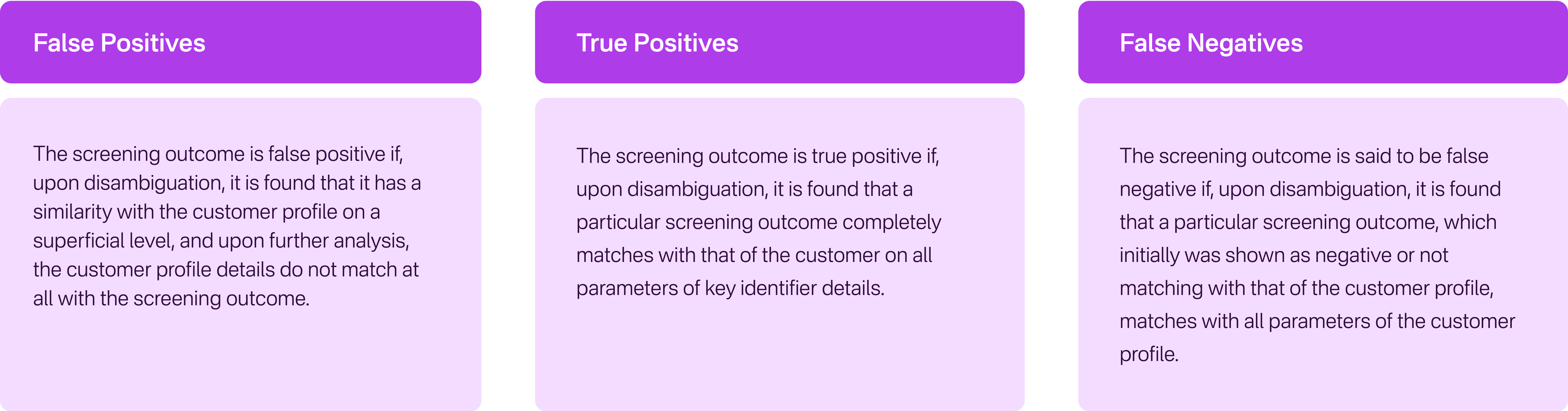
False Positives refer to matches that are generated by screening software due to some level of similarity with the prospective customer’s profile details, which, upon disambiguation, are categorised as false positives as the details of these matches do not match with the details of the prospective customer’s profile.
False Negatives refer to matches that, upon disambiguation, are identified to have been falsely categorised as negative results.
Causes of False Positives in Name Screening by TCSPs

The issue of false positives is detrimental to effective Name Screening as it eats away Screening Analyst's time in disambiguating a large number of false positives, which could have been avoided or eliminated if the Name Screening Solution had been well-calibrated. False positives drain TCSPs’ resources and time.
4. Data Quality Issues
Data quality refers to the accuracy and format in which a TCSP collects and retains data pertaining to its customers. If the data quality is inaccurate, inadequate, incorrect, or is kept in a format that is inconsistent, mismanaged, or across different types of formats. In such situations, the TCSP is bound to face a problem while aiming to achieve efficiency while conducting Name Screening. Name Screening requires entering customer data into a screening solution to generate output; if customer data quality is substandard for any reason, then screening accuracy gets directly impacted.
5. Integration Issues
Another pain point faced by TCSPs when conducting Name Screening is integration issues. Integration issues are problems encountered when trying to streamline various tools, such as software, processes, and workflows, to meet compliance requirements and organisational goals. Integration issues generally arise due to technical difficulties, compatibility issues, redundant or legacy systems, lack of scalability and flexibility, or licensing permission issues.
6. Multi-Jurisdictional Compliance
TCSPs face the challenge of ensuring multi-jurisdictional AML/CFT compliance, particularly when the scope of their services, as well as their client requirement, extends beyond a single jurisdiction. In situations where a TCSP has a multi-jurisdictional presence or client base, the TCSP needs to consider multiple sanctions and watchlists and ensure compliance with local and international TFS requirements.
When the Rules Change Across Borders, Your Tools Shouldn’t Break
Screen Beyond Borders
Acknowledging pain points or challenges faced in Screening by TCSPs is just the first step, as it helps identify and understand the existence of a challenge or pain point. The next step is to identify the consequences emanating from such challenges. Identifying and understanding various types of consequences helps TCSPs understand the gravity and impact of such challenges on their day-to-day operations.

Consequences Due to False Positives
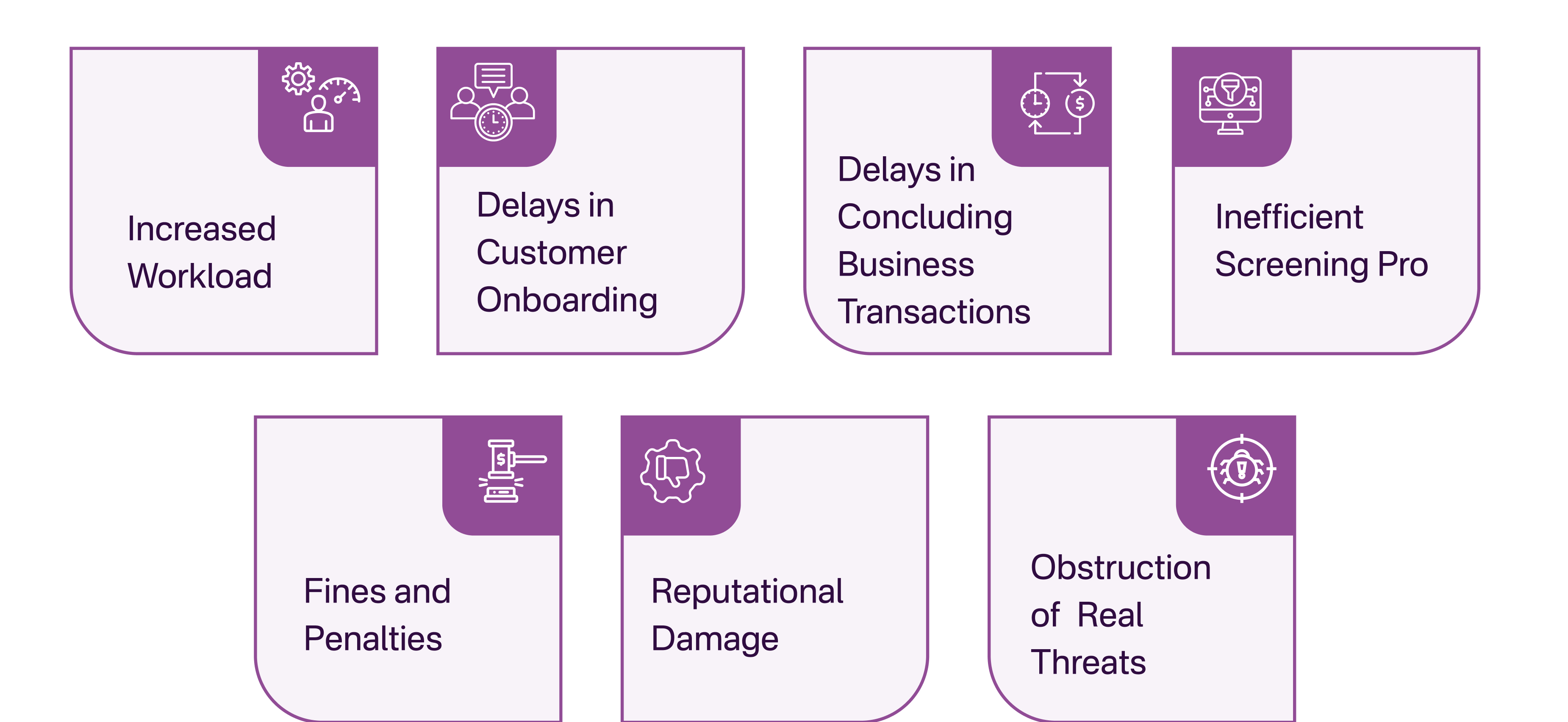
The pain point of false positives comes with its own set of resultant consequences. The TCSP, dealing with a high number of false positives, must also deal with the following.
Consequences of High False Positive Rates on TCSPs during Sanctions Screening Outcome Analysis
Regulatory Fines and Penalties
The regulatory fines and penalties are an immediate consequence of the challenges faced by TCSPS. Especially when TCSPs have a multi-jurisdictional presence and need to implement group-wide AML/CFT policies and procedures, balancing the AML/CFT obligations and data privacy and security obligations across jurisdictions may lead to breach of some or the other local laws or regulations due to a number of factors such as ongoing monitoring difficulties, and data quality issues leading to the imposition of fines and penalties on the TCSP.
Loss of Business Reputation
Any TCSP facing challenges in terms of cost constraints in achieving adequate AML/CFT compliance, ongoing monitoring issues, data quality, and accuracy issues face the risk of business reputation. Imposition of a single fine or penalty or the appearance of a TCSP’s name in adverse news pertaining to facilitation, partaking, or participating, even if it is unintentional, leads to the loss of the TCSP’s business reputation.
High ML/TF & PF Risks
Needless to emphasise, the challenges in efficient name screening directly make way for ML/TF and PF risks higher than those calculated during the Enterprise-Wide Risk Assessment (EWRA) basis on which control measures are determined. TCSPs need to take technical implementation issues into account while determining residual risk and testing control efficiency.
Increased Compliance Costs
The elements of false positives and negatives, integration issues, and multi-jurisdictional compliance lead to an increase in AML/CFT and TFS compliance costs due to the false positives and negatives draining the productivity of the Screening Analyst. Ensuring multi-jurisdictional compliance is not every AML Compliance Officer’s /MLRO’s cup of coffee. It requires skilled precision on jurisdiction-wise compliance as its niche expertise. Employing such skilled and experienced AML COs and MLROs costs dearly for TCSPs. Integration issues lead to functional and operational overlaps as well as blind spots, leading to the overall rise in compliance costs.
Adverse AML Audit Findings
When there is an onslaught of several challenges in name screening, the AML Audit’s findings are bound to highlight where screening measures have gone wrong for the TCSP. Not having a robust name screening process and tools leads to adverse AML findings, requiring TCSPs to spend heavily on remedial measures.
Increased Costs Towards Remedial Measures
Factors like adverse AML audit findings, loss of business reputation, and a high number of false positives, all create a domino effect in making the remedial exercise to remove screening issues a draining cost centre. TCSPs not investing in efficient screening processes later pay in terms of remedial measures.
What’s the Point of a Net that Catches Small Fishes, but Misses Big Ones
Target True Risks. Rapidly
After knowing the grievous consequences that a TCSP can face due to challenges in efficient name screening, TCSPs can largely benefit and safeguard themselves against these consequences by understanding how RapidAML helps solve TCSP screening problems.
RapidAML simplifies Name Screening Obligations for TCSPs in UAE through its multi-faceted capabilities, such as the following:

Business Process Automation
Business Process Automation refers to automating manual processes and workflows that can be replicated or repeated in pre-defined sequences or patterns. Business Process Automation helps streamline tedious and time-consuming manual repetitive tasks, particularly in the AML compliance context, where tasks such as name screening require the repetitive action of screening one customer after another. RapidAML’s Screening Software helps TCSPs automate their obligation to conduct name screening of their prospective and existing customers.
Real-Time Screening
Time is of the essence when conducting name screening. If screening watchlists or sanctions lists are outdated, the screening outcome won’t be accurate. Also, if the screening process is time-consuming, it may lead to the possibility of missing out on potential matches. RapidAML solves this by ensuring real-time screening by providing the latest screening lists and completing the screening process when all mandatory information is in the blink of an eye.
High-Quality Data
RapidAML generates top-notch data in terms of screening results, screening registers, and case registers. The high-quality data generated helps comply with the record-keeping requirement and is interlinked with the document repository feature of RapidAML, facilitating easy retrieval of information required with just a few clicks. The high-quality data also helps the AML Compliance Officer or the MLRO in decision-making due to the high accuracy, devoid of human errors.
Reduction in False Positives
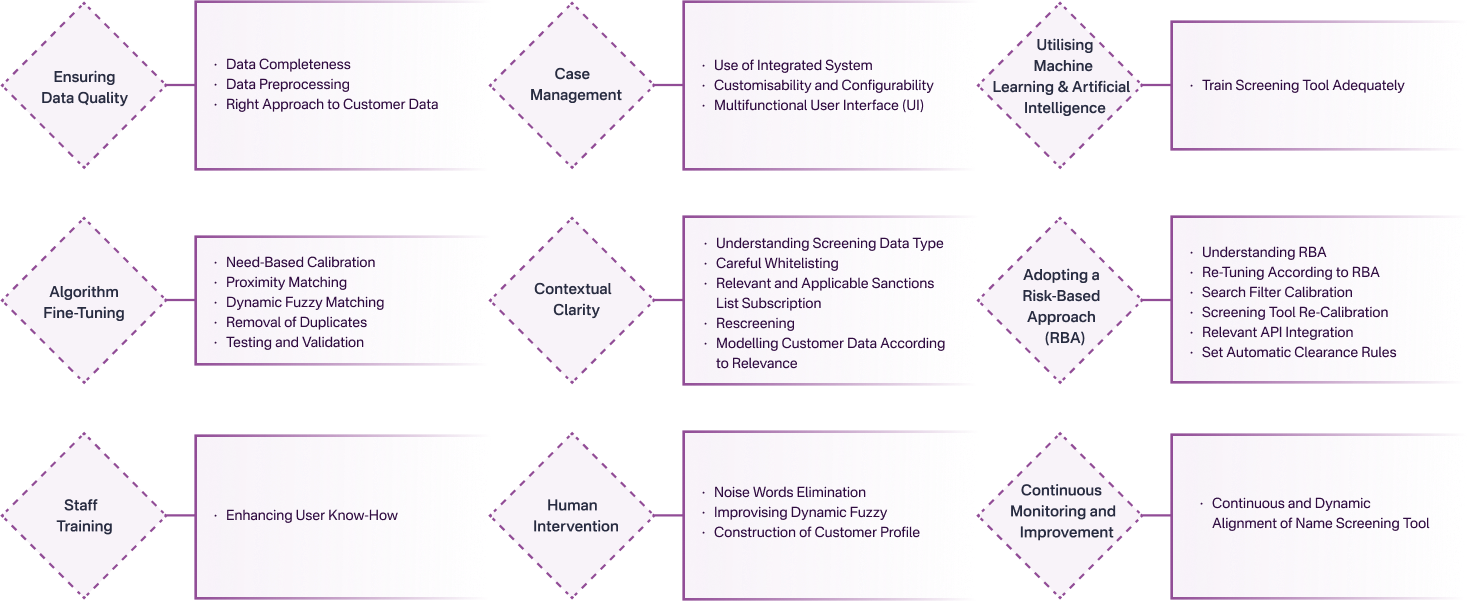
The occurrence of False Positives is a major pain point for TCSPs in the UAE. RapidAML drastically reduces false positives as it uses fuzzy logic when it comes across language variation and phonetic considerations. Also, the customisability and configurability of the RapidAML Screening Software help reduce the probability of false positives. The infographic below summarises how RapidAML helps TCSPs reduce false positives.
How RapidAML Helps TCSPS Minimise False Positives
Refer to our YouTube Video: Effective Approaches to Reducing False Positives in Sanctions Screening | RapidAML
AI-Driven Screening
The AI-powered fuzzy matching ability of RapidAML helps reduce the time spent disambiguating a high number of false positives and facilitates faster decision-making.
Batch Screening
Automating the repetitive screening task is just not enough. RapidAML simplifies screening by facilitating screening in bulk! Once bulk screening is done, the screening analyst is given the ability to disambiguate each result individually, serving compliance purposes while making the screening process quick.
Easy-to-Use User Interface (UI)
RapidAML does not add to the worries of a TCSP’s AML Compliance team when it comes to understanding and decoding the complex UI of the screening software. RapidAML’s intuitive Screening UI is very simple to understand, simplifying the screening process for TCSPs in the UAE.
Ongoing Monitoring
The screening aspect of AML compliance is an ongoing process, not a one-time checklist. RapidAML supports continuous monitoring by enabling Legal Professionals’ AML Compliance Officers to classify each client’s status as accepted, rejected, inactive, dormant, or exited. Based on these classifications, the system automatically carries out ongoing monitoring tailored to each client’s profile. It generates alerts or notifications whenever it detects matches, anomalies, or inconsistencies by comparing initial client data against updated information from over 700 global watchlists, PEP lists, and adverse media sources—ensuring vigilant and up-to-date AML compliance throughout the business relationship.
KANBAN Board for Task Management
The name screening process often involves multiple team members with distinct roles—from front office staff handling document collection and data entry, to screening analysts reviewing results, and ultimately the AML Compliance Officer making final determinations. RapidAML simplifies collaboration by offering a Kanban Board that provides a clear, real-time view of task assignments and progress across the team. This ensures transparency, accountability, and efficient workflow management for Legal Professionals.
Seamless Integration
Integration refers to the capability of software to seamlessly connect and interact with other systems, tools, or processes by sharing information. It ensures smooth communication and coordination between different software applications, enabling cross-functional workflows across an organisation. RapidAML’s ability to integrate with various platforms—such as client onboarding systems, customer relationship management (CRM) tools, and billing or invoicing software—helps Lawyers, Notaries, and Other Legal professionals overcome integration challenges and streamline their compliance operations.
Implementation Support
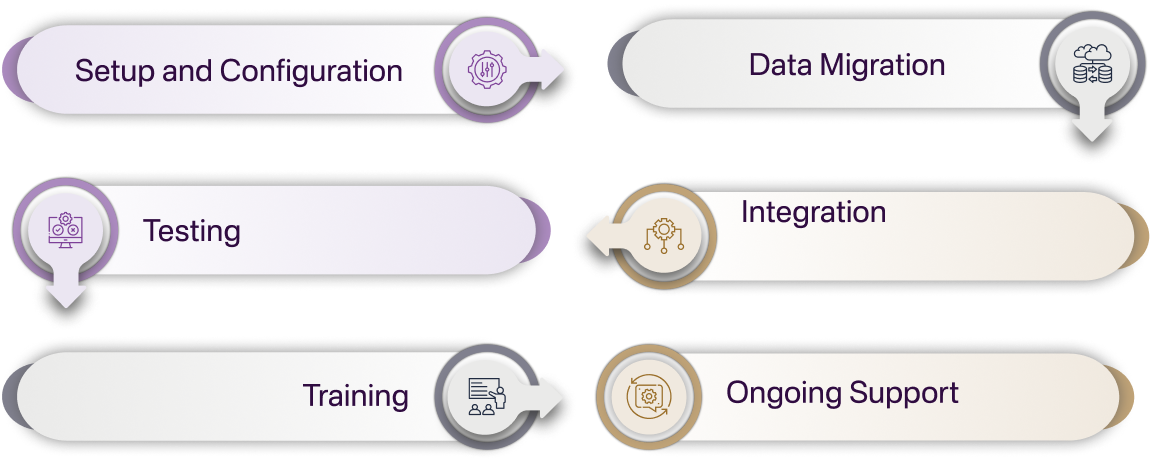
RapidAML goes beyond simply providing screening software—it offers comprehensive implementation support to ensure Lawyers, Notaries, and Other Legal Professionals are fully equipped to use the system effectively. The team provides in-depth training to personnel on how to conduct screenings, generate reports, access case registers, modify onboarding workflows, and more. The implementation process for Lawyers, Notaries, and Other Legal Professionals in the UAE is illustrated in the infographic below.
Customisable Thresholds
RapidAML offers complete customisability when it comes to setting thresholds for screening outcomes. Recognising that each legal professional’s compliance needs are unique, RapidAML allows customisation of watchlists, criteria, and result-generation thresholds to tailor the screening process precisely to their specific requirements.
Easy Disambiguation
RapidAML’s screening software streamlines the process of match resolution by automatically categorising screening results into segments such as Sanctions, Politically Exposed Persons (PEPs), and Adverse Media. This structured presentation enables Lawyers, Notaries, and Other Legal Professionals and compliance analysts to quickly assess each match and determine whether it is false, partial, or a true positive, enhancing both accuracy and efficiency in AML compliance efforts.
Document Repository
RapidAML enables Lawyers, Notaries, and Other Legal Professionals to maintain comprehensive records of client and prospect screening activities, including screening outcomes and supporting documents. These records are securely stored on the cloud and retained for the duration mandated by the relevant Supervisory Authority, helping Lawyers, Notaries, and Other Legal Professionals meet their AML record-keeping obligations with ease and reliability.
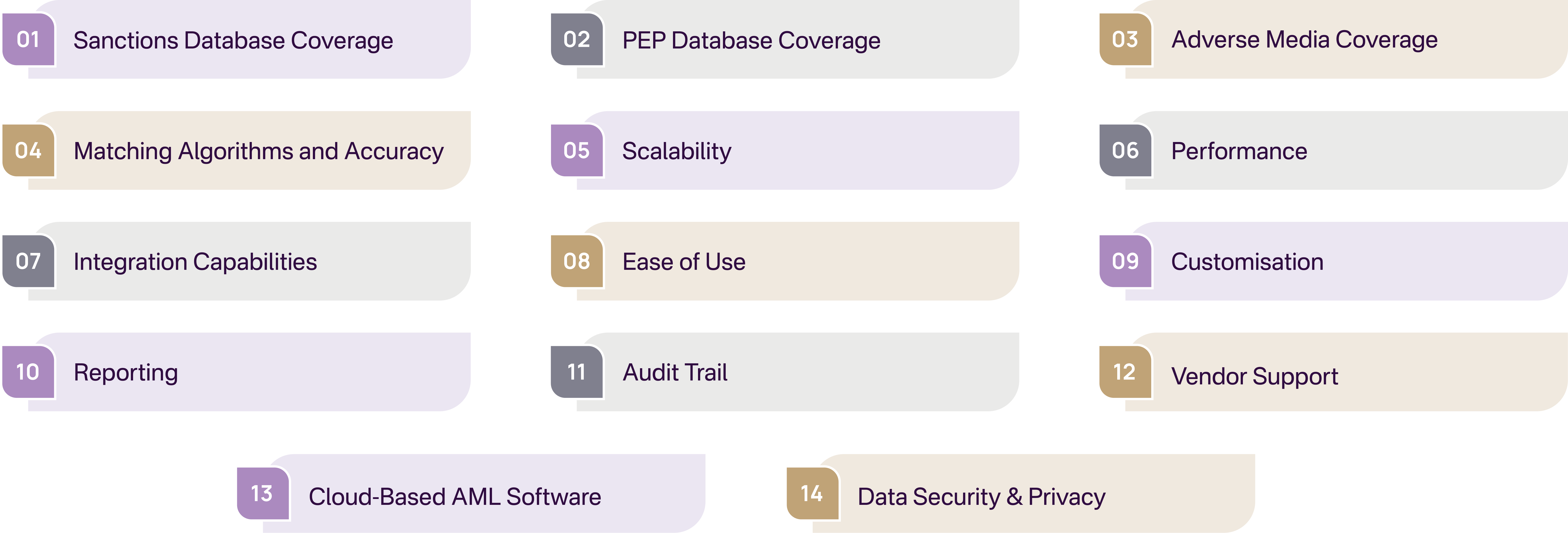
RapidAML Screening Software isn’t just like any other name screening tool. It is created and curated to imbibe UAE’s AML/CFT and TFS obligations applicable to TCSPs while mitigating commonly faced pain points and the consequent challenges they face. The distinguishing features of RapidAML are expanded below to help TCSPs in the UAE understand how switching to RapidAML is the answer to all their screening issues.
What Survives the Four-Eyed Principle?
Thoughtful Systems. Thoughtfully Built.
Success stories are built with strategies, course correction, and relentless effort to ensure that the TCSP operates within regulatory compliance parameters. The best practices to attain screening software implementation success are as follows:

Screening Software Requirements Identification
A TCSP in UAE must be clear as to what its screening obligations are according to its own specific needs, based on its risk factors such as customers, geography, delivery channel, mode, and volume of transactions.
In simple words, the ML/FT and PF risk identification measure, i.e., screening solution, must be chosen and configured according to the latest EWRA of the TCSP and TFS requirements while ensuring alignment with the vision and mission of the TCSP’s growth and expansion. This helps the TCSP to identify the jurisdictions against which watchlists and sanctions lists to screen their prospects and customers.
Additionally, it also helps the TCSP to configure screening parameters in their screening solution accordingly. Ultimately, this will pave the way towards achieving organisational goals.
Identify Migration Requirements
Be it switching from manual to RapidAML, another screening software to RapidAML, or from one name screening tool to another, the TCSP must thoroughly examine the prerequisites of the name screening solution it intends to migrate to.
Identifying migration needs helps with preparing or modifying the existing customer data and files in the data format that the new name screening software accepts, processes, and delivers error-free results. Any mismatch in alignment with data transfer requirements might have adverse consequences, such as loss of data, leading to a breach of recordkeeping requirements, business loss, and loss of trust and reputation.
Another potential consequence is a breach of data privacy and data security protocols, resulting in fines and penalties. Also, TCSP must be very mindful of understanding and aligning migration requirements when selecting name screening software and must select a screening software that helps with hassle-free data migration.
Select, Test, and Fine-Tune Name Screening Software
Test driving the screening solution is non-negotiable. Having done the test drive, a TCSP can identify areas in the name screening software to be implemented that need fine-tuning and customised configurability to meet their organisational needs.
For instance, if a TCSP purchases a screening solution, it should make sure that they get the workflows and escalation pathways fine-tuned according to their organisation chart so that there are no post-implementation pains where the employees are in a state of confusion.
Other aspects that TCSPs need to be mindful of in the context of ensuring fine-tuning are selecting the match percentage, defining whitelists, and defining screening parameters for regulated and unregulated activities.
TCSPs must also ensure that the name of screening software, match percentages, close or exact match types, screening deceased persons or not, whitelists created, etc., are mentioned and updated in the TCSP’s AML/CFT policies and procedures, forming part of control measures deployed by the TCSP.
Allocate Adequate Resources
TCSPs must bear in mind that name screening is a mandatory compliance requirement. Meeting compliance requirements incurs costs, but it's a necessary precaution that protects TCSPs from hefty fines, loss of business licenses, or even imprisonment, which can amount to hundreds of thousands.
TCSP must conduct a study of the cost-to-benefit ratio and allocate adequate resources for name-screening software so that they can use name-screening software on a long-term basis without the need to switch solutions and worry about migration prerequisites.
TCSPs should view investing in effective screening software as an essential measure to prevent the repercussions of non-compliance when implementing a screening solution.
Define Users and their Roles
TCSPs must formulate a screening software implementation plan where the capabilities of employees, hierarchy escalation matrix, and workflows are mapped with the screening solution proposed to be implemented.
This can be done by defining and configuring users and their roles in the screening solution to be implemented, as this mapping activity is what makes or breaks a name-screening software’s successful implementation.
This can be easily achieved with adequate vendor support and their ability to analyse the needs of the TCSP and handhold their employees in the initial stages of implementation by helping them transition from pre-implementation workflow to post-implementation workflow and take steps to bridge gaps, if any, through training and awareness programs.
Configure Alerts, Workflows, and Timelines
TCSPs must not miss out on customising the functionalities and escalation pathways of a name-screening software and making the most out of the features and capabilities of the name-screening software they select and use.
Configuring alerts, notifications, and task completion timelines is the action item on the part of a TCSP, which, if combined with good screening software, can help the TCSP achieve name-screening compliance excellence.
Integrate Name Screening Software
TCSPs must make the most out of the integration capabilities of the name screening software they select. This helps reduce overlaps in effort and minimises overall operational costs for the TCSPs.
Integration can be done with CRM, accounting, invoicing, and other AML software, such as transaction monitoring, customer risk assessment, customer due diligence, etc. Case management is one such software that TCSPs must consider when attempting to unify integrated solutions under a single dashboard.
Assessment of Post-Implementation Outcomes
TCSPs must continuously assess the post-implementation outcomes to analyse the cause of the success/failure of the name screening software.
This helps with ensuring alignment with organisational goals for compliance at all times; any deviation from it suggests screening failure, increased instances of false positives, and an unending disambiguation workload on screening analysts, requiring remedial measures such as re-configuration, re-training, or change of screening software, etc.
This assessment also helps with identifying post-implementation scalability in a true sense, such as whether the TCSP can continue with the same software when expanding business or if it would need to look for alternatives. These decisions are made easy by having ongoing viability testing of the screening software, helping ensure compliance and operational success.
Re-tune Configuration to Keep Pace with Evolving Needs
Fine-tuning or tweaking jurisdictions whose sanctions lists are to be subscribed, and re-tuning ongoing monitoring lists are some examples of the aspects TCSPs need to make part of their best practices.
There are numerous factors contributing to the need to re-tune the configuration of screening tools as changes in regulatory requirements, business expansion, changes in FATF grey lists or blacklists, changes in sanctions regimes or bilateral or multilateral relations. Such changes must be made in the screening software to ensure that there is no laxity in compliance.
Refer to our YouTube Video: Best Practices in Sanction Screening Software Implementation | RapidAML
Intelligence that Doesn’t Intimidate
Good Implementation is Part Science, Part Stagecraft
Name Screening for TCSPs in the UAE can be simplified by devising a well-thought-out screening solution implementation strategy. RapidAML’s solutions and consulting services go hand in hand, helping TCSPs in the UAE navigate the complexities of AML/CFT and TFS compliance requirements, particularly concerning screening obligations.


Enterprise-Wide Risk Assessment Software
Get Started
Contact Us