AML Software for Dealers in Precious Metals and Stones in UAE
Name screening software facilitates DPMS by automatically checking prospective and existing clients against UAE local terrorist list and global sanctions lists, politically exposed persons (PEP) lists, and adverse media sources to identify probable involvement in ML, FT, and PF activities and report the same to the UAE FIU in a timely manner.
This page focuses on understanding the regulatory framework, federal decree law, cabinet decisions, sector-specific guidelines and mandatory compliance obligations for Dealers in Precious Metals and Stones in the UAE and how AML software for Dealers in Precious Metals and Stones in the UAE gives them a strategic advantage by automating their AML compliance functions.
KYC Software simplifies customer identification and verification while helping DPMS to gain adequate clarity on the nature and purpose of the business relationship and implement risk-based customer due diligence measures.
Building on this, Customer Risk Assessment Software facilitates DPMS in assigning accurate risk scoring to every customer profile based on the degree of ML, FT, and PF risk such a customer poses to the DPMS.
Additionally, Transaction Monitoring Software helps identify anomalies and discrepancies in customer transactions that might be indicative of underlying suspicious activities.
A regulatory reporting software facilitates regulated entities with the preparation and submission of required reports to the UAE FIU to ensure the organised and diligent handling of necessary reports to regulators.
Regulatory Framework Governing Dealers in Precious Metals and Stones in UAE
DPMS in the UAE are required to adhere to the AML, CFT, and CPF laws in the UAE, namely:
Federal Decree-law No. (20) of 2018
Federal Decree-law No. (20) of 2018 on Anti-Money Laundering and Combating the Financing of Terrorism and Financing of Illegal Organisations.
Cabinet Decision No. (20) of 2019
Cabinet Decision No. (20) of 2019 Regarding Terrorism Lists Regulation and Implementation of UN Security Council Resolutions on the Suppression and Combating of Terrorism, Terrorists Financing & Proliferation of Weapons of Mass Destruction, and Related Resolutions
Requires TCSPs to ensure that customers are screened across relevant UNSCRs to prevent terrorism financing.
Guidelines for Designated Non-Financial Businesses and Professions
Cabinet Decision No. (10) of 2019
Cabinet Decision No. (10) of 2019 Concerning the Implementing Regulation of Decree-law No. (20) of 2018 on Anti-Money Laundering and Combating the Financing of Terrorism and Illegal Organisations.
Cabinet Decision No. (74) of 2020
Cabinet Decision No. (74) of 2020 Regarding Terrorism Lists Regulation and Implementation of UN Security Council Resolutions on the Suppression and Combating of Terrorism, Terrorist Financing, Countering the Proliferation of Weapons of Mass Destruction and its Financing and Relevant Resolutions.
Subscribe to the mailing list maintained by the Executive Office for Control and Non-Proliferation (EOCN),
Screen customers and transactions,
Apply adequate TFS measures
Submit relevant reports to the authorities
Taking TFS measures and making it impossible for individuals or organisations to secure funds, assets or economic resources to proceed with their illicit intentions.
Supplemental Guidance for Dealers in Precious Metals and Stones
What are Precious Metals and Precious Stones in UAE AML Regulations?
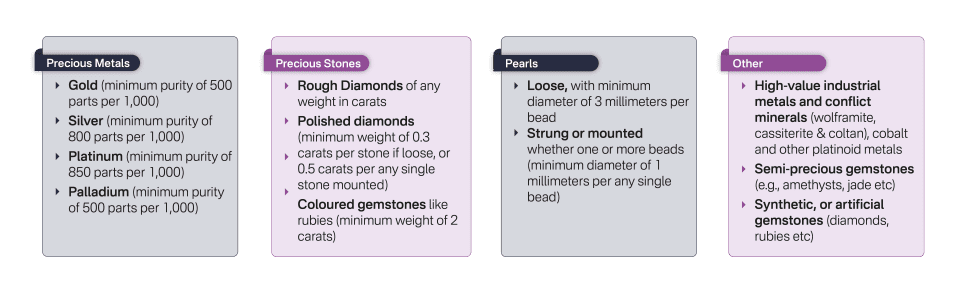
Generally accepted classification of precious metals and precious stones is based on factors such as quality, intrinsic value, and rarity. Under UAE AML regulations, the following are considered Precious Metals and Stones:
Who is a Dealer in Precious Metals or Precious Stones (DPMS)?
A dealer in Precious Metal and Stones (PMS) may be considered to be any natural or legal person (or legal arrangement), or their employee or representative, who engages, as a regular component of their business activities, in the production and/or trade of precious metals or precious stones, whether in raw, cut, polished, or elaborated (mounted or fashioned) form.
Under the UAE AML laws, dealers in precious metals and stones (DPMS) are considered Designated Non-Financial Businesses and Professions (DNFBPs) when they engage in carrying out any single monetary transaction, or several transactions which appear to be interrelated, whose value is equal to or greater than AED 55,000 and are subject to specific AML/CFT obligations under the AML/CFT legislative and regulatory framework of the UAE. Such transactions are referred to as ‘covered transactions’ for DPMS in UAE.
However, it should be noted that regardless of whether DPMS is carrying out covered transactions or not, they need to adhere to the TFS requirements.
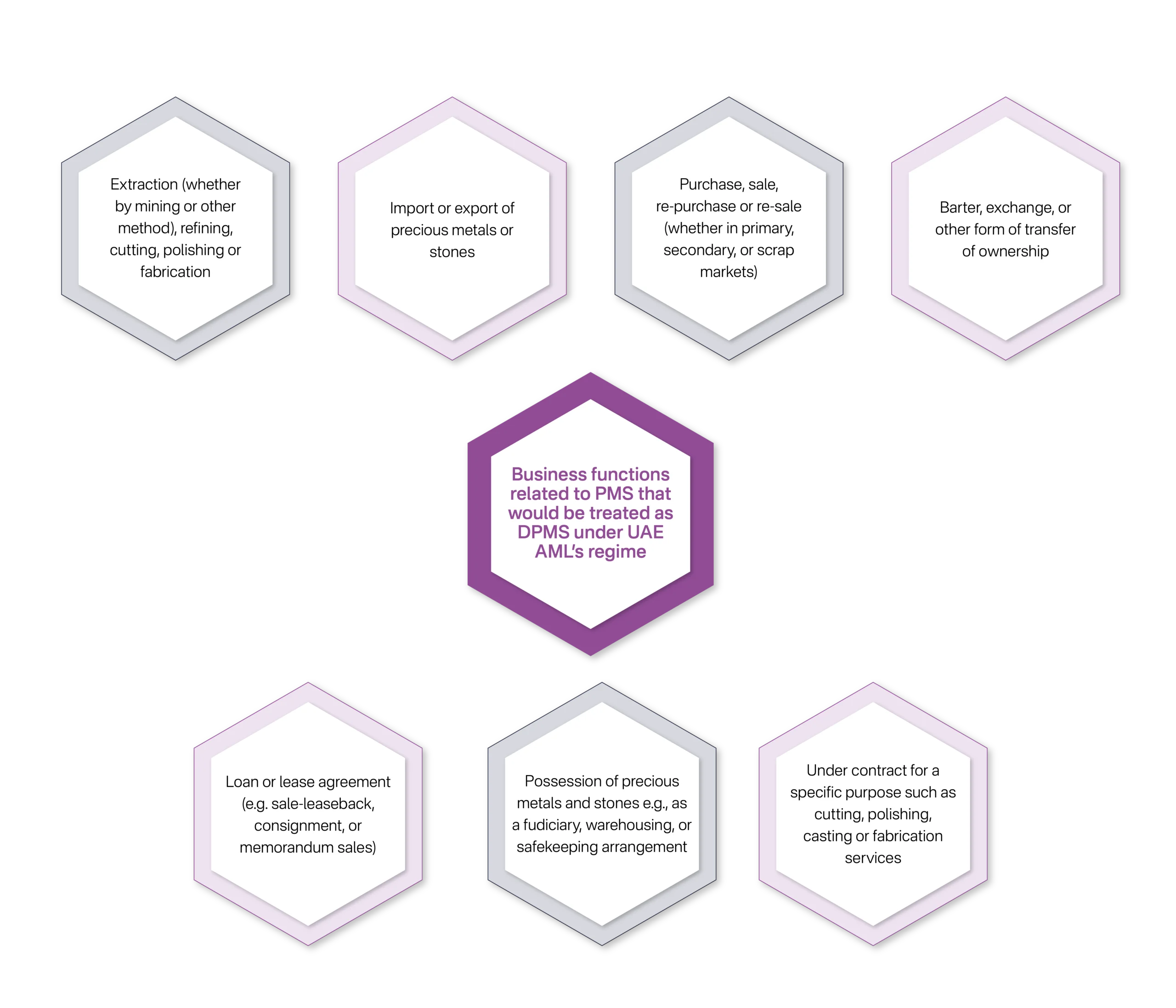
Following business activities carried out by an individual or entity related to precious metals and stones (PMS) would be treated as a dealer in precious metals and stones (DPMS) in UAE:
The above-referenced conditions are irrespective of whether:
The transaction is wholesale or retail
It is direct or indirect (such as through a broker or other intermediary)
It is between natural or legal persons or legal arrangements, including any other DPMS
The PMS are traded physically or virtually (for example, via certificates, on electronic exchanges, or via the internet)
Irrespective of where or by whom the physical goods are warehoused, held in safekeeping, or delivered.
Under the AML-CFT Law and the AML-CFT Decision, DPMS are obliged to apply the required AML/CFT measures when they qualify as DNFBPs. For the purpose of applying AML/CFT measures in respect of “covered transactions”, DPMS should also consider PMS to include any object which at least 50 per cent of its monetary value is comprised of PMS. DPMS should also take a similar risk-based approach to the application of AML/CFT measures in respect of covered transactions involving other types of metals and stones.
Dealers in Precious Metals and Stones and Their AML Compliance Obligations in the UAE
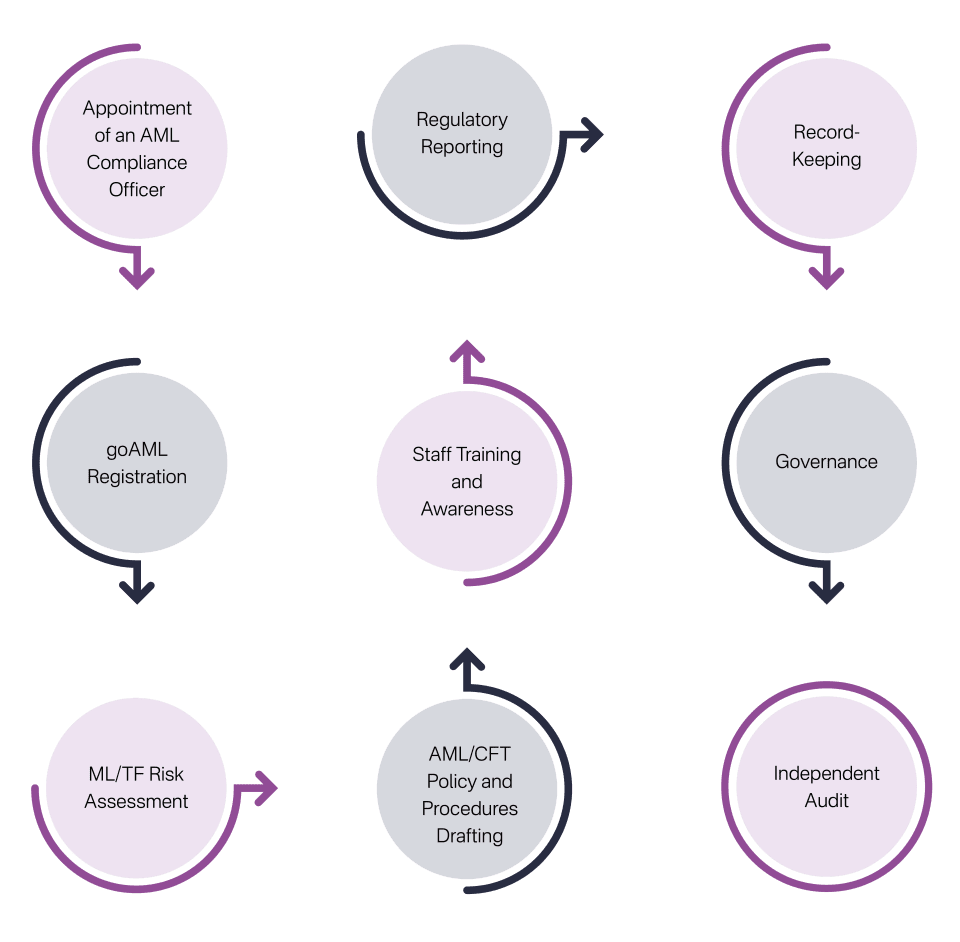
It must be noted that certain AML/CFT obligations under the AML-CFT Law and AML-CFT Decision are independent of whether or not DPMS engage in covered transactions. DPMS should ensure they allocate adequate resources and have adequate procedures in place to apply the measures, as required.
Appointment of an AML Compliance Officer
Every Dealer in Precious Metals and Stones (DPMS) is legally mandated to appoint a competent AML compliance officer or a Money Laundering Reporting Officer (MLRO) to ensure the quality, strength and effectiveness of DPMS AML/CFT program & reviewing, scrutinising and reporting STRs. The CO is also responsible for helping establish and maintain a strong & effective AML/CFT compliance culture for DPMS. This is a prerequisite of goAML Registration for the Dealers in Precious Metals and Dealers in Precious Stones.
goAML Registration
Every DPMS in the UAE must get itself registered with the FIU’s goAML Portal to file regulatory reports when they encounter suspicious activity, suspicious transactions, or when they engage in certain transactions requiring additional reporting. The process of goAML registration on UAE FIU’s goAML portal is approved by the relevant and applicable supervisory authorities in UAE.
ML/FT and PF Risk Assessment
Each DPMS faces different ML/FT risks, which warrant a thorough evaluation of potential vulnerabilities and must adopt a Risk-based Approach (RBA), as prescribed under law. The Dealer in Precious Metals and Precious Stones must also conduct the Enterprise-Wide Risk Assessment (EWRA) Process to help assess the overall risk of ML/FT/PF, so as to understand the likelihood of each scenario materialising, evaluate the quality of existing controls, and additional measures required to manage residual risk.
As the ML/FT risks are constantly evolving, every DPMS must customise its risk management program, detailing the AML/CFT policies and procedures, ensuring that the AML program is proportional to the nature & size of DPMS’s operations and risks identified during EWRA. The AML/CFT Program must provide controls and risk mitigation measures while factoring in emerging ML/FT trends and typologies around the Precious Metals and Precious Stones sector. Every DPMS must deploy the AML/CFT policies and procedures corresponding to the risks evaluated, and they must be clear and comprehensive to help the AML Compliance Officer and the staff understand their compliance-related responsibilities and navigate the AML tasks.
AML staff training is a crucial compliance obligation for every Dealer in Precious Metals and Stones. Adequate AML training must be a part of the new employee orientation program, and a refresher course for all employees, be it customer-facing or the compliance team, to create an awareness about recent AML developments and AML compliance obligations while ensuring they are adequately trained to identify ML, FT and PF red flags that DPMS are susceptible to and report them to the UAE FIU through the goAML Portal.
Regulatory Reporting
DPMS operating in UAE are required to furnish a Dealer in Precious Metals and Stones Report (DPSMR) on the goAML Portal to report cash transactions or transactions involving international wire transfers (for legal persons) amounting to AED 55,000 or above.
They are required to implement appropriate internal control mechanisms to identify potential ML/FT risks and report suspicious activities or transactions to the FIU in a timely manner by filing:
Dealers in Precious Metals and Stones Report (DPMSR)
Every dealer in precious metals and stones must maintain all AML-related records and documents, as well as CDD files, including identification documents, AML training logs, transaction monitoring documents, and suspicious transactions and activity reports submitted on the goAML Portal for 5 years. DPMS registered with ADGM’s FSRA or DIFC’s DFSA are required to retain the records for 6 years.
For more insights into record-keeping under the UAE’s AML/CFT law, refer to:
To support a robust AML compliance culture within the organisation, the AML/CFT program must be supported by senior management. The three lines of defence serve as a governance structure for DPMS in UAE.
For more insights into governance through the Three Lines of Defence, refer to:
DPMS must implement an independent AML Audit function to ensure periodic testing of the quality, efficiency, and adequacy of the AML/CFT measures deployed and remediate any gaps. A robust and independent audit function is a key component of a well-functioning governance structure and an effective AML/CFT framework.
Adopting a Risk–Based Approach (RBA) for Customer Onboarding by DPMS in UAE
All DPMS that qualify as DNFBPs are required by the AML-CFT Law and the AML-CFT Decision to fulfil certain obligations that constitute the basis of an effective risk-based AML/CFT programme with respect to covered transactions.
When required to apply AML/CFT measures, DPMS acting in any capacity, carrying out any one or more covered transactions through PMS related business activities in the UAE, should carefully consider customer risk, geographic risk, channel risk and product service & transaction risk factors to determine nature and type of counterparty/customer, product/service, or transaction.
In assessing ML/FT risk and assigning risk ratings to their customers, DPMS may utilise a variety of methods, depending on the nature and size of their businesses. Irrespective of the method used by DPMS, the risk mitigation measures must be clearly documented and consistently applied across their business activities.
DPMS are obliged to take the necessary steps to mitigate and manage the ML/FT risks to which they are exposed, given the inherent vulnerabilities of the Precious Metals and Stones sector. DPMS must use their judgement, knowledge, and expertise to develop an appropriate risk-based approach customised to their business structures and activities. This helps DPMS adhere to the sector–specific guidelines for DPMS, the UAE AML-CFT laws, and the FATF recommendations concerning conducting customer due diligence (CDD) with a risk-based approach (RBA).
Given the complexity of regulations, sophistication of financial crimes, and vulnerabilities of Dealers in Precious Metals and Stones in the UAE, manual AML compliance is no longer a viable strategy as manual processes are prone to a higher risk of compliance gaps and are time-consuming. Effective AML software provides a suite of integrated tools designed to automate and strengthen the compliance process, providing real-time monitoring and comprehensive audit trails. A unified AML software enables Dealers in Precious Metals, Dealers in Precious Stones and Jewellers to reduce their operational risk by enhancing accuracy and improving risk detection capabilities by deploying technology that is efficient and scalable, thus making technological solutions fundamental for DPMS to achieve and maintain robust AML compliance in the UAE.
AML Software: Key to Robust AML Compliance in UAE for DPMS Sector