AML Software for Real Estate Brokers and Agents in UAE
This page provides a brief overview of the key Federal Decree Laws, Cabinet Decisions, and sector-specific guidelines that apply to real estate brokers and agents in the UAE. It also explores how a unified AML software solution helps real estate professionals automate and manage their compliance responsibilities more effectively.
KYC Software facilitates Real Estate Brokers and Agents in UAE with collecting and verifying customer identification details, simplifying business ownership structures, and documenting the nature and purpose of business relationships.
Name Screening Software helps automate screening customers against UAE local terrorist lists, UNSC consolidated lists, and global sanctions lists, politically exposed persons (PEPs) databases, and adverse media sources for any probable ML, FT, or PF risk that requires further scrutiny at the time of customer onboarding, during the course of a business relationship, and even after completion of business relationship, for a period of five years.
Building on this, a Customer Risk Assessment Software analyses every customer profile and assigns an appropriate risk rating, which in turn helps determine the degree of due diligence and ongoing monitoring required.
Combined with anomaly detection and pattern recognition capabilities of Transaction Monitoring Software, and ease of regulatory reporting offered by Regulatory Reporting Software, Real Estate Brokers and Agents in UAE can capitalise on integrated AML Software to fulfil their compliance obligations.
Regulatory Framework Governing Real Estate Brokers and Agents in the UAE
Transactions involving the sale, purchase, leasing, and financing of real estate have long been established as a typology for money laundering and the financing of terrorism. The misuse of the real estate sector by criminals involved in ML/FT can have widespread harmful effects on the national economy. UAE’s AML/CFT framework thus treats real estate transactions as high-risk, and Real Estate Professionals are required to adhere to the AML, CFT, and CPF laws in the UAE, namely:
Federal Decree-law No. (20) of 2018
Federal Decree-law No. (20) of 2018 on Anti-Money Laundering and Combating the Financing of Terrorism and Financing of Illegal Organisations.
Cabinet Decision No. (20) of 2019
Cabinet Decision No. (20) of 2019 Regarding Terrorism Lists Regulation and Implementation of UN Security Council Resolutions on the Suppression and Combating of Terrorism, Terrorists Financing & Proliferation of Weapons of Mass Destruction, and Related Resolutions
Requires TCSPs to ensure that customers are screened across relevant UNSCRs to prevent terrorism financing.
Guidelines for Designated Non-Financial Businesses and Professions
Cabinet Decision No. (10) of 2019
Cabinet Decision No. (10) of 2019 Concerning the Implementing Regulation of Decree-law No. (20) of 2018 on Anti-Money Laundering and Combating the Financing of Terrorism and Illegal Organisations.
Cabinet Decision No. (74) of 2020
Cabinet Decision No. (74) of 2020 Regarding Terrorism Lists Regulation and Implementation of UN Security Council Resolutions on the Suppression and Combating of Terrorism, Terrorist Financing, Countering the Proliferation of Weapons of Mass Destruction and its Financing and Relevant Resolutions.
Subscribe to the mailing list maintained by the Executive Office for Control and Non-Proliferation (EOCN),
Screen customers and transactions, (potential, existing, and former customers for a period of five [5] years after completion or termination of business relationship)
Apply adequate TFS measures
Submit relevant reports to the authorities
Taking TFS measures and making it impossible for individuals or organisations to secure funds, assets or economic resources to proceed with their illicit intentions.
Supplemental Guidance for Trust & Company Service Providers
TCSPs are required to adhere to the AML, CFT, & CPF laws when they carry out covered activities under the AML regime. The business activities performed by Real Estate Professionals that are considered covered activities under UAE’s AML regime are as follows:
Business Activities by Real Estate Professionals Covered Under UAE’s AML Regime
Real estate brokers/agents and Lawyers, Notaries, and other Legal Professionals engaged in the transaction pertaining to the buy/sale of real estate.
Lawyers, Notaries, and other Legal Professionals representing one (or, in some instances, more than one) party to a transaction
Intermediating between the parties in terms of negotiation and execution of an agreement or contract
Acting in a fiduciary, trustee, or secretarial capacity with regard to the transmission, delivery, and/or recording of various financial instruments, securities, bonds, title deeds, or other documents and information related to real estate transactions
Arranging, advising or consulting on financial resources, including obtaining mortgage financing, for the completion of a real estate transaction.
The laws and regulations concerning real estate in the UAE vary depending on the location or the Supervisory Authority involved.
DNFBPs, including brokers and real estate agents as well as lawyers, notaries and other legal professionals who engage in activities related to sale and purchase of real estate on behalf of customers, are required to fulfil AML/CFT obligations based on an effective risk-based approach under UAE AML/CFT framework.
Single Unified Platform for all AML Needs
Forget the Manual Process and Run Compliance Smarter
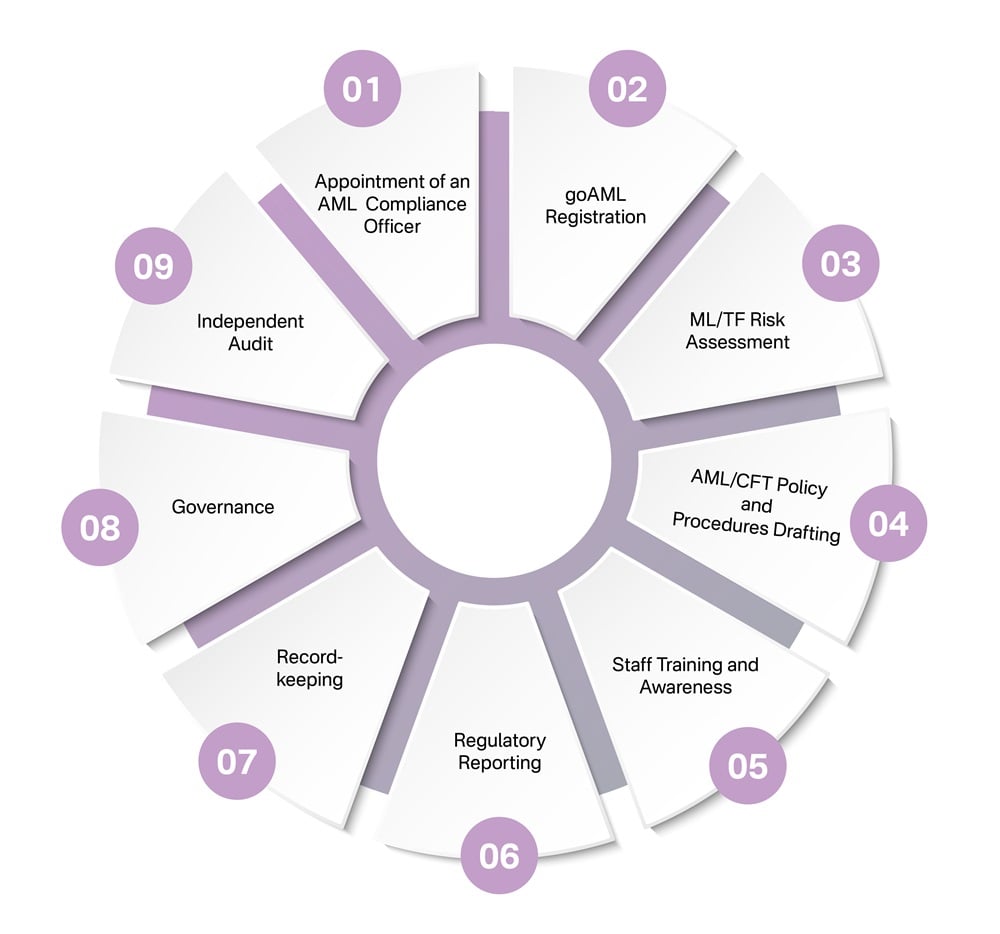
Real Estate Brokers and Agents and Their AML Compliance Obligations in UAE
Appointment of an AML Compliance Officer
Every real estate firm must appoint a qualified AML Compliance Officer (AML CO) responsible for overseeing and ensuring adherence to AML/CFT obligations. The AML CO ensures the firm’s AML policies are implemented effectively and that SARs are filed as and when needed.
goAML Registration
Real estate brokers and agents must register on the UAE FIU’s goAML portal and are obliged to register and report suspicious transactions via goAML. Timely filings and registration of reports ensure compliance with the UAE’s AML framework and fulfil their compliance obligations.
ML/FT and PF Risk Assessment
As DNFBPs, real estate brokers and agents must conduct a comprehensive Enterprise-Wide Risk Assessment (EWRA) to evaluate ML/FT/PF exposure.
This includes identifying risk factors across customers, products, services, and geographies, assigning risk ratings, and applying the appropriate level of due diligence after evaluating overall firm exposure.
Every DNFBP, as a broker or agent, or acting in the same capacity, must have well-documented AML/CFT policies and procedures proportional to its size and risk to combat ML/FT risk the real estate firm faces. This should include CDD process, beneficial ownership checks, transaction monitoring rules, mode of payments, escalation protocols and name screening. Firms must continually update their policies to reflect changes in the regulatory framework in the UAE and keep up with emerging risks and threats.
For more insights into AML/CFT policies and procedures, refer to:
Real estate professionals must ensure that all customer-facing agents, managers, and the compliance team are well acquainted with the AML/CFT obligations, red flags, and reporting procedures. The firm must provide regular AML/CFT training to all employees to ensure that they are well-trained with the latest updates and able to detect any suspicious transactions. For more insights into Staff Training and Awareness, refer to : AML/CFT Training and Awareness Programs for Effective KYC Implementation
Regulatory Reporting
DNFBPs, such as real estate agents, brokers, lawyers, notaries, independent legal professionals and independent accountants who are engaged in transactions involving the sale and purchase of real estate, are obligated to report suspicious transactions and cash payments on the goAML portal. Reports that must be filed in a timely manner are:
Real Estate Activity Report (REAR)
Suspicious Transaction Report (STR)
Suspicious Activity Report (SAR)
Confirmed Name Match Report (CNMR), formerly known as Funds Freeze Report (FFR)
Real Estate Brokers and agents, including lawyers, legal professionals and other independent accountants must retain all AML/CFT records for at least five years from the date of transaction or account closure which enables real estate firms to maintain a clear audit trail and ensures compliance obligations are fulfilled.
Real estate firms involved in related transactions must implement a comprehensive AML/CFT framework, anchored by strong internal governance and a culture of compliance. Senior management should set a clear tone from the top and ensure accountability across all levels, spanning business units, compliance officers, and leadership by regularly testing adherence to established policies and controls.
Real estate agents and legal or natural person engaged in real estate transactions must conduct routine internal audits of their AML procedures to validate compliance and identify any control weaknesses or regulatory gaps and the effectiveness of CDD process. All independent audit findings must be properly documented.
Know Everything Miss Nothing
From Policy to Practice-Everything Compliant and Regulator-Ready
Adopting a Risk-Based Approach (RBA) for Customer Onboarding by Real Estate Brokers and Agents in UAE
Real estate businesses classified as DNFBPs under UAE AML-CFT Law and Decision are required to establish a robust risk-based AML/CFT programme and assess key risk factors including customer profile, geographic location, transaction channel, and product/service type when conducting property-related transactions in the UAE.
In applying AML/CFT measures, firms must determine the nature and risk level of each counterparty or transaction. Risk ratings may be assigned using methodologies suited to the business’s size and operations. Regardless of the approach, all risk mitigation procedures must be clearly documented and consistently implemented across business activities.
In UAE, the real estate sector, given the volume and complexity of transactions, needs to deploy unified AML software that is crucial for effective compliance, as it integrates KYC, customer onboarding, Name screening (sanctions and PEP screening), transaction monitoring, and case management and flags suspicious activity like unusual cash payments or complex ownership in real time. This minimises manual work, strengthens audit trails, and enables teams to focus on investigating anomalies. Investing in end-to-end AML compliance solutions ensures scalable, robust controls aligned with UAE AML/CFT laws.
AML Software: Real Estate Brokers and Agents’ Key to Robust AML Compliance in UAE